Friday, November 18, 2011

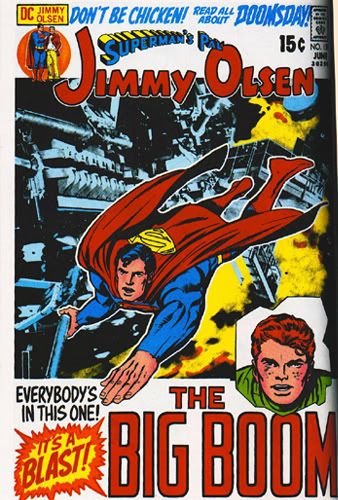
Fourth World Fridays: Superman's Pal, Jimmy Olsen #138--"The Big Boom!"


Wow, Superman meets Doomsday? We’re about 20 years early on that particular encounter!

I think it says something about the Fourth World epic that I could manage to grow bored with a storyline that features a secret civilization of hippies living below the Earth’s surface, clones of the Newsboy Legion, a Hulk-Jimmy and a Four-Armed Thing, but bored I have become. The fact of the matter is that, in about half the time it’s taken for this storyline in SPJO, Orion has infiltrated Apokalips and come to Earth, Mr. Miracle has begun his act and escaped his archnemesis, and the Forever People have arrived, moved in, had their apartment blown up, and been captured by religious fundamentalists. Compared to that, even as wild a storyline as this business with “The Project” is going to seem to drag on.

Of course, considering what’s coming in the next issue…

But let’s repress that for a while and pick up where we left off. As you may recall, Darkseid’s minions Simyan and Mokkari had accidentally, but conveniently, managed to breed exactly the kind of life form they needed: a four-armed yellow rock monster who feeds voraciously on nuclear energy. Said four-armed terror had smashed his way into the Project and was on the verge of causing a massive hull breach in the Project’s power plant, thus exploding the entire Wild Area—and the city of Metropolis, above. Superman had zoomed to head it off, and Jimmy Olsen and the Newsboys had followed him for God only knows what reason, given that Superman didn’t want them and they only got in the way. They all ended up trapped in a bizarre molecular pink rubber egg. Obviously.

Meanwhile, on the first of several splash pages, the Newsboy Legion’s dads are demonstrating from whence the Newsboys Mk II get their recklessness and stupidity by piling in after Superman, taking the Golden Guardian and several transport carriers full of troops with them. “The Evil Factory has jammed all communications with our atomic power plant! We can’t warn them!” Proclaims one of the military types as they streak down the zoomway through the underground chasms. OK, but, uh, warn them of what? I mean, it would be nice, I guess, but again, these guys are headed towards ground zero of a massive nuclear detonation (in fact, last issue there were already a bunch of explosions going off, but Kirby seems to have forgotten about those). Superman is there already, and either he’s going to stop the monster himself, in which case their efforts will be unnecessary, or else he’s not, in which case it seems unlikely that a truckload of ineffectual army men are going to make a difference and are fairly likely to just get fried. But hey, this is a Kirby comic, and heroism and reckless endangerment go hand in hand!

Kirby begins a countdown—apparently the events of this issue span a mere fifteen minutes, and you could cut the tension with a knife. Superman is finding that the “big, stupid alien egg”, as Scrapper dubs it, is too flexible and yielding for him to work up the necessary leverage to burst their way out, which is actually a clever way of taking him out of action. The Newsboy’s efforts to break free result in their bouncing back and knocking each other around like pinballs.

TOMMY: Well, that does it! Whad’da we do now-- just wait till we’re hatched?
SCRAPPER: Yeah! Dis is some yolk!
SUPERMAN: Cool it, men! Let’s think--not panic!
JIMMY: I’d rather panic than listen to those jokes!

I mention this exchange because it’s virtually the only memorable thing Jimmy says or does in this issue of his own comic. Not that I’m particularly complaining about a shortage of Olsen.

Meanwhile, on the sixth splash page of what is so far an 8-page story—ah, Kirby—the yellow rock-monster is gouging his way towards a typically ornate power plant. Apparently the monster is smart enough to know to dig up and under the feet of the guards, but the guards aren’t smart enough to be able to tell that the tremblors the monster is causing are coming from directly below them.

Back at the egg, Superman (with, OK, some help from Jimmy) has figured out that the egg’s surface will respond to energy, and generates a blast of static electricity by rubbing his hands together at top speed. That actually almost makes sense, sort of—it even ties into what we saw last issue. Gasp! We’re now seven minutes “to fiery end!” so Supes has to hustle. And we have to—

Check in with Perry White! Wow, hey, another Superman cast member. As you may recall, one of the elements of the current Superman storyline is that the Daily Planet has been bought up by Galaxy Broadcasting, which is apparently a front for Intergang, and its head honcho, Morgan Edge, has been openly conspiring with Darkseid and trying to kill Superman. I’d kind of assumed he’d given ol’ Perry the boot, but, great Caesar’s Ghost! Here he is, still doing the hard-boiled editor bit! And sexually harassing interns!

No, just kidding. He’s having a perfectly normal conversation with Terry Dean, a character apparently left over from the pre-Kirby storyline. She does play a part in the story much, much later on, but I’m not sure what the point is of bringing her in now, when having Lois Lane would have made a lot more sense. But, since all the traditional Superman characters were being redrawn against Kirby’s wishes, I guess he wanted to avoid that when possible, so no Lois. The only point here is to establish that Perry’s suspicious of Morgan Edge, so let’s move on.

The old Newsboys, the Guardian, and the troops burst out into the wild area and locate the Legion’s Whiz Wagon. Watching via one of those omniscient viewscreens that seem to come standard with every villainous characters’ evil headquarters, Simyan and Mokkari apparently believe that these guys pose a threat to their plans, despite the fact that they’re already facing Superman, so they teleport the rest of their four-armed brood over to the Project to wreak exponentially more havoc. Man, these guys can see most of what the heroes do, and can send monsters over to harass them at will? That just makes it all the more pathetic when Superman beats them.

But what of the villainous Morgan Edge? I’m sure you’re dying to know. After a perfunctory demonstration of his eeeeeeevilness--he fires his secretary--Edge gets a call via the secret monitor in his desk, telling him to split for a copter on the roof, because Metropolis is about to go up in a gigantic mushroom cloud. Taking this in stride, Edge heads to the door and then, amusingly, has to act casual while walking past his employees to the elevator.

What? Oh yeah, there’s a life-or-death struggle going on back at the Wild Area. I forgot. “Three minutes to violent eruption!” Proclaims Kirby in his narrative caption. Superman bursts in and tussles with the maddened rock monster, only to be thrown across the room and hit with the power plant’s damper rods, with the monster throws at him. They shatter on Superman’s chest, natch, but the reactor is about to go critical! “It is one minute to blow-up!” Kirby reminds us. I get the sense he was struggling with his vocabulary while writing this issue, because the next box reads, “As if to nail down this fact to Superman, the glistening threshold appears—and from it pours an army of D.N.Aliens!!!!”

And they’re met by the army troops!

Again, Kirby was a WWII vet, and it’s pretty obvious he believed that the army was capable of meeting any crisis, but come on. ONE of these things bested Superman—now they’re facing a whole army of them? Kirby tactfully leaves the “bullets bouncing off them as they charge in and create total carnage” offscreen, but it’s pretty obvious that’s what’s happening.

The Guardian, rather unbelievably, manages to put down a rock monster with his fists—that’s his big contribution to the issue—as Superman kills two birds with one stone. Picking up the overloading reactor (“ thirty seconds to Eternity!”) Superman carried it down the corridor to a series of tunnels that were being built to tap into the core’s geothermal energy, and throws it into a very large, deep pit. Not only does the blast take place a safe distance underground, but the rock monsters, blindly seeking the atomic energy that is their nourishment, hurl themselves down the pit after it “Like maddened lemmings!” Good thinking, Superman!

Returning back up the corridor from this apocalyptic scrape, Superman finds Jimmy sulking over the fact that he’s been sidelined in his own comic. Some sub-He-Man level humour wraps up the issue…

And the Project storyline! Whoo-hoo! Alright! Not only is Supes about to get back to fighting crime on the surface (where, you’d think, Lex Luthor would have pretty much conquered the world by now) but we’re about to leave the Newsboy Legion behind for a long, blessed stretch of time! And begin one of the stupidest, most ridiculous low points in the entire Fourth World saga!

Uh…wait…Simyan? Mokkrari? Got any more monsters to throw at us? Please?

Saturday, November 12, 2011

Comics Quickies: American Vampire


Just read the first collection of American Vampire, a series co-created and co-written by Stephen King, though the other writer, Scott Snyder, seems to be a true partner (according to his afterward, he created the central character of Skinner Sweet). It's a clever "mosaic" story with two threads in each issue; the first, set in 1925 and written by Snyder, stars wannabe starlet named Pearl who falls afoul of an evil, bloodsucking Hollywood producer. And also he's a vampire. BA-RUM-PUM! The second is written by King, set in the wild west, and tells the story of the aforementioned Skinner Sweet, a particularly nasty outlaw who ends up antagonizing the same ancient vampire, at this point a railroad baron, and is seemingly brought to justice by a hard-eyed but good-hearted sheriff. The two stories interweave in all kinds of clever ways, slowly revealing more and more about the various characters and suggesting an epic story that will probably move forward across the 20th Century in later issues. In the meantime, King's really on his game here--I haven't read much of his stuff since the mid-90s, and nothing since the Dark Tower ended, so I don't know how his batting average is these days--but this has all the best qualities of his work with none of the flaws that used to rankle me (it actually has a tight ending! Which doesn't rely on the characters suddenly developing magical abilities!). His dialogue and characterization are strong as ever, with Sweet being an instantly memorable character, and the conflict between two evils, with a good man caught in the middle, being an interesting one. Meanwhile, Snyder matches him beat for beat in the Pearl storyline; I'd argue his dialogue is sometimes a bit too contemporary for 1925 (though I suppose Hollywood was the cutting edge of culture) but like King, his characterizations are sharp and the use of vampires as a metaphor for Hollywood is just cute enough without being overplayed. Then there's Rafael Albuquerque, who draws both stories. His art is kind of amazing, expressionistic and even "cartoony" without losing a realistic, gritty feeling, and his characters are just as instantly distinctive art-wise as they are in terms of the writing. Sweet in particular, who looks like Kid Rock's great-grandpappy, is always instantly recognizable no matter what timeline he pops up in, which is of course crucial to a story that jumps between decades and viewpoints.

For those of you who, like me, were rather disappointed by the Dark Tower comics, this is proof of how good a Stephen King comic can be.

Friday, November 11, 2011

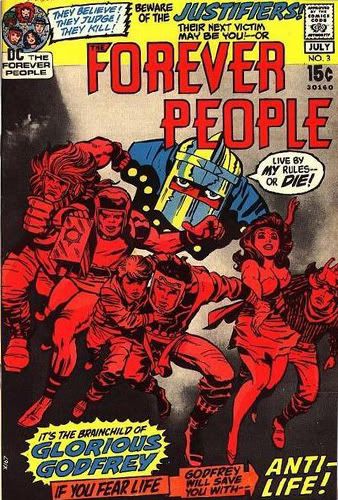
Fourth World Fridays: The Forever People #3--"Life Vs. Anti-Life"


You probably don't need me to describe the many and various ways in which comics' growth were stunted over the decades. The long and the short of it is that being confined to disposable kid's entertainment for so long meant that the innovators often weren't quite able to shake off the status quo when attempting to do something "important" and "meaningful" within the comics medium. This was probably most evident in the early 70s, when comics started to enter a true adolescent phase--meaning that they started yearning for "adulthood" (being treated as a respectable medium) but, for the most part, weren't sophisticated enough to know how to go about it. The results were often strange, to say the least. This is the era in which Spidey bucked the comics code by having a friend fall to heroin addiction, Steve Ditko created a string of Objectivist superheroes, and Green Lantern and Green Arrow teamed up for a really heavy-handed commentary on America and everything that was wrong with it. The results fluctuated between "interesting" and "painfully self-important", but the fact of the matter is, trying to shoehorn "serious issues" into what had until very recently been a defiantly juvenile genre was a very ill fit. It would take a lot of tinkering before we started to get superheroes who could mesh comfortably with the "real world" and all its messiness, and some would argue that we never really got there.

Kirby, ambitious scamp that he was, was not immune to this impulse--in fact, he and Stan Lee had essentially opened the floodgates with their original Marvel line-up (which, let's not forget, included a weapons manufacturer who was a POW in Vietnam and a gang of mutants constantly on the run from prejudice). The main difference there, though, was that the politics were just part of the backdrop, spice to stories that were otherwise focused on the important business of long underwear types beating each other up. When superhero comic writers moved political commentary to the fore, they were generally unable to deal with it except in the straightforward, black-and-white, over-the-top manner in which they'd handled alien invasions and world-shattering conflicts.

Kirby was no exception to this; it's just that his world view was so vast, and so bizarre, that the Deep Important Meanings frequently went past self-importance and awkwardness and became just another ingredient in the surreal landscape of Kirby's world.

Frequently, but not always.

In The Forever People #3, Kirby tackles an issue that's proved just a tad divisive over the years: organized religion. Given the countercultural bent I've noted so often in these essays, I don't think you'll be surprised by Kirby's take on the subject. The story starts with a quote by Adolf Hitler, an army of blank-eyed citizens spouting hatred of those who are different, and a freakishly magnetic red-haired cult leader who has them in his thrall.

What? No, it's not Jimmy Olsen! It's Glorious Godfrey, who makes no secret of his Apokaliptish affiliation, his reverence for Darkseid, and his worship of the Anti-Life equation. The only thing remotely subtle about this four-page sequence is that Kirby doesn't outright refer to Godfrey as a religious leader. But come on: the guy's followers meet in a giant tent containing a huge organ, and Godfrey wears white, billowing robes while standing at a pulpit. And his name is God-Free. I'm kind of surprised there wasn't more of an uproar over this comic, but then, this wasn't the 50s, with Wertham and whatnot. This was the 70s, and America had a lot more to worry about than some subversive comics.

"Life has pitfalls! Anti-life is protection!" Proclaim the unsubtle banners toted by Godfrey's followers. "Life will make you doubt! Anti-life will make you right!" And, most crucially, "You can justify anything with anti-life!" More on this in a moment, but for now, you can see how this relates to what I was talking about, above. No real wannabe totalitarian would advertise himself as promoting "anti-life" or honk on about how he was giving you the right to kill and inflict pain. Real-world villains always make it about something else, something that nobody could disagree with, while sneaking in their more pernicious and mean-spirited views in a roundabout way. But because this is a comic, we have to have it spelled out in broad strokes.

But while he may have been unsubtle, Kirby was canny. Godfrey's creating an army of "Justifiers" who do his bidding mindlessly--the name coming from their ability to justify doing anything in the name of Godfrey, Darkseid, and Anti-Life. It's still cartoonish, but that is pretty bang-on. Kirby's point is that a lot of religious fanatics are concerned less about doing whatever's necessary to save their souls than about using their religion to justify their own violent or hate-filled impulses. I'm having a hard time arguing with that viewpoint, personally...

On literally the next page, we see Godfrey's methods bear bitter fruit for our heroes. With no explanation, a Justifier stands in the middle of our hairy, unwashed heroes' new home base, shaking down lil' Donnie--that's the Tiny Tim lookalike from the last issue, remember him?--and demanding to know where the Forever People are, despite the fact that they're standing right behind him. "Motherbox has bent the light around us--scattered the sound vibrations!" Explains Vykin hurriedly. Oh, OK...that explains one aspect of this scene. But how did this guy get in? How did he know the Forever People lived there in the first place? And if his bosses knew, why did they send a single guy, instead of an onslaught of Justifiers?

Well, we get a partial explanation for that last one, as the Forev Peeps rescue Donnie and bail out of the apartment (Big Bear literally goes through the wall.) See, the Justifier is carrying an Apokoliptish bomb, and he's capable of, as Beautiful Dreamer reminds us, justifying his own death. Yes, that's right: the Justifier is a suicide bomber. Ouch. That's almost painfully prescient.

The FPs just barely escape by diving into a convenient bulldozer-dug hole, and pause to reconnoiter. Realizing that the Apokolips war/invasion has begun in earnest, and that there'll be no more zany hippie monkeyshines for them, the gang decides to abandon the apartment they spent much of last issue furnishing, and hit the road. Well, the apartment is pretty much a smoking crater by now anyway, but even if it wasn't it would still be the right decision. Having these guys hang around the poor neighbourhood of Genericburg isn't nearly as interesting as having them pull an Easy Rider and take a trek across that weird old America. Which is especially weird when Kirby's drawing it.

This, of course, means they have to abandon Donnie. HOORAY!!!!

Sorry to be so blunt about it, but it doesn't seem like a particularly emotional parting for the FPs, either:

BIG BEAR: On board! On board!
BEAUTIFUL DREAMER: Goodbye, Donnie! We leave you what cannot die--love! Friendship!
SERAFIN: It is so in New Genesis! It can be here!
DONNIE: You must come back! You must!
BIG BEAR: Preparing for phase-out!

And then, in a flurry of really dumb technobabble and paying no further heed to Donnie whatsoever, the FPs blast off into the sky.

Good thing, too, because the Justifiers are about to launch their attack on the city. Declaring that "the people we've chosen as targets live here," the Justies pour out of their flying box in a wave of dickishness:

JUSTIFIER #1: Don't bother to discrminate! The women and children are as hated as the men!
JUSTIFIER #2: Waste no time on mercy! Drag them out! Treat them rough!
JUSTIFIER #3: Listen to their cries! I've been waiting to do this for years!
JUSTIFIER #4: Get going! We'll show what we do with your kind!

Man, dig that naturalistic dialogue. I know I've been wasting entirely too much time on mercy these days. Many's the morning where I'll just sit in my breakfast nook, unable to get going on the day's work, because I'm just feeling too darn merciful.

Seriously though, what "kind" are we talking about here? Nothing's specified, and for once I think that has less to do with Kirby's awkward writing style than the fact that he wanted to tiptoe around editorial and the comics code. The obvious suggestion is that the Justifiers are Nazi-ish, which would make the people they're rounding up Jews (of which, I need hardly remind you, Kirby was one). But like I said above, everything else in the book points to the Justifiers being religious cultists, and the comparisons to totalitarianism aren't helped by the fact that the Justifiers mention repeatedly that they want to avoid the police. Oh, and the quasi-medieval clothing seems more Spanish Inquisition than Fourth Reich, too. Though I guess those guys weren't fond of the Jews either.

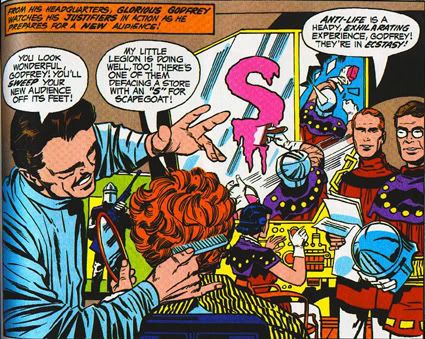
There's also a brief nod to Fahrenheit 451, as a Justifier enters a library and torches it with a flamethrower, to prevent the spread of dangerous ideas. That would be somewhat more effective if there weren't thousands of other libraries throughout the country, but OK. Godfrey watches through his dressing room mirror-slash-omniscient viewing device as another one defaces a store:


Well, it's still more logical than "S" for Shakespeare. (Scroll down.)

Godfrey uses the power of technobabble to determine that the Forever People are still alive, and prepares for an invasion of tonight's ceremonies by...well, not doing anything, really. By the way, does it seem like Godfrey's assistants in the panel above are modeled after someone in the real world? I'm guessing some kind of early 70s evangelists or religious leaders. Anyone know?

The FPs land just out of view of Godfrey's revival tent and do what they always do: call on Deus Ex Machina Man, I mean Infinity Man, to solve everything. This month, Infy can pass through solid rock at will, and bend lasers--or rather, "Omega beams"--fired at him by the Justifiers, turning them back on his enemies.

"You fool!" Cries Godfrey to Infy's back. "Do you think your spectacular gimmickry can stop this operation?" Huh, apparently Godfrey likes to compliment people as he's insulting them.

GODFREY: The forces of Apokolips are many! --And mighty!
INFINITY MAN: Your secret is wind, Godfrey! An evil wind that rushes from your throat--

Lord, I hope it's from your throat...

INFINITY MAN: --And this Demon's organ! Which must be destroyed!

Ooooooh, I get it. It was the organ all along!

Actually, that's kind of interesting--the Apokoliptians are seeking the Anti-Life Equation, which will make everyone do their bidding, but it seems like Godfrey's organ got them pretty close already. Granted, properly deployed, the Equation can control everyone in the Universe, but still, it seems to me, just follow the Borg model of assimilating everyone into Justifiers, and you've got a pretty good head start. Except Infinity Man just smashed the organ, so back to square one, I guess.

SUDDENLY! An ominous gloved hand lands on Infy's shoulder! "Turn about! Look at me!" Instead of spinning and punching him in the face, Infy looks vaguely up and to the left and soliloquizes. "That voice! It chills the spirit--like the coming doom of all living things!" It's Darkseid, natch...he just happened to be in the neighbourhood, apparently. Or, OK, I guess this is what Godfrey did to prepare for Infinity Man's incursion: called the boss to help him. Fine, fine, whatever.

Anyway, Darkseid shoots cheesy beams into Infy's eyes--through his goggles, yet--and disburses him back into the various Forever People. Apparently the power of cosmic love from beyond infinity is still no match for Darkseid. Or else the plot required him to take a dive.

No sooner have the Forev Peeps reappeared than Desaad pops up and neutralizes them all with a "nerve beam" which, we're told, causes them to yelp loudly before they collapse. We're told this because Kirby apparently couldn't be bothered to draw it, which is weird given that he proceeds to devote the remaining three pages to Darkseid describing the plan he's been implementing for ten issues now, Godfrey jealously vying with DeSaad for Darkseid's favour, and Desaad cacklingly describing the horror that awaits the FPs in his "Camp".

So, at the end of the day, I'd say Kirby pulls off tackling deeper subjects pretty well, without forgetting to give us a neat comic book. Furthermore, with the FPs leaving their pad behind and hitting the road, the book finds its groove. And on top of that, it's a neat cliffhanger in which Infinity Man, for once, doesn't provide a magic solution to the gang's woes. You can definitely sense Kirby finding his feet and gaining in confidence.

The next couple of issues of The Forever People continue the trend of satire and social commentary. Will Kirby lose his way, or gather steam? Stay tuned, true believers...

Thursday, November 10, 2011

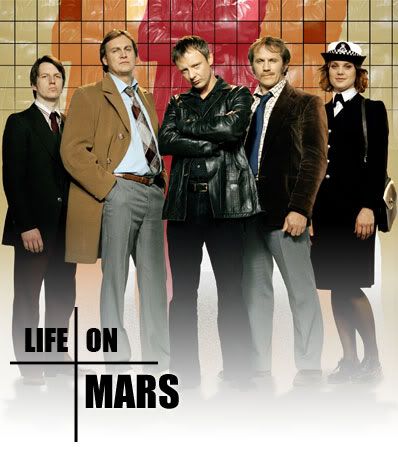
TV Thursdays: Life on Mars


As always, SPOILERS follow.

It’s taken as read that endings are crucial to fiction, but is it possible that, in the medium of television, they might not be as important? I can see arguments both ways. I believe the ending of “Lost” is a genuine disappointment, one that completely fumbles the balls the series had been keeping in the air up until that point, but large swathes of the show are still well worth watching, and aren’t significantly diminished by where the story ended up. I think the ending of Battlestar Galactica is good—not great, but good—but it doesn’t change the fact that the show went off the rails in its final season. The finales of Star Trek: The Next Generation (good), The X-Files (bad), and Buffy the Vampire Slayer (mediocre) don’t change the respective quality of the series as a whole.

But then, I have to admit, one of the reasons I can blow off The X-Files and Lost in particular is that I became convinced pretty early on that they weren’t going to stick the landing, that the “big reveals” they’d been implicitly promising throughout the show weren’t going to come together dramatically, even if we technically learned everything by the end. X-Files tripped over its own continuity and narrative coherence one too many times by around the third season to convince me the writers had a plan, and if there’s a more obvious example of TV writers stringing their audience along ad nauseum than Lost’s first two seasons, I can’t think of it. Again, I like both these shows, but I decided not to put my trust in a logical meta-narrative and just enjoy it on an episode-by-episode basis early on.

Conversely, when Life on Mars set up an intriguing meta-story in its pilot, I figured it was going somewhere cool. Not an unreasonable assumption—the show was smartly written from the start, it was well-reviewed, and given that it was British, there was a comparatively short run of episodes, so it wasn’t unreasonable to think that they might have told a tight, 16-part story with a satisfying payoff. So the fact that said payoff completely failed to arrive may have coloured my outlook on the whole series more harshly than it otherwise might have.

The show concerns Sam Tyler (John Simm), a cop in Machester, 2006, who’s in pursuit of a serial killer. When his girlfriend and partner (which…I don’t know much about how the police operate in Britain, but that seems like a bit of a stretch, that you would be allowed to have an open romantic relationship with your partner) pursues a hunch and apparently gets snagged by the killer, Sam races frantically to catch her and is hit by a car. To his befuddlement, he wakes up in what seems to be Manchester, 1973, an exaggerated Starsky-and-Hutch-style TV cop show reality where everyone is a slightly (or heavily) corrupt chain-smoker and heavy drinker, women are only there to be harassed, and police methods involve slapping suspects around until they talk. This brave new world is embodied by Detective Chief Inspector Gene Hunt, played by the magnetic Philip Glenister as a perpetually pissed-off man’s man’s man who takes a blunt-force approach to police work. While questioning the reality around him, Sam also finds himself bringing his modern, logical, and liberal sensibilities to bear on reforming the system, confiding in WPC Annie Cartwright about his former life and providing the voice of conscience for Hunt and his fellow officers.

As with Mad Men, the show focuses on the culture clash between the past and present, more literally in this case, with episodes about the racist and sexist atmosphere of the police station and England in general, the more sexually freewheeling era (masking a heavy level of male privilege), and the corrupt and slapdash nature of police work, compared with Sam’s more meticulous, logical, and by-the-book methods. 1973 tends to come off rather badly in these comparisons, though there is one heartfelt episode decrying the state of soccer/football, and how it’s become a haven for thuggery and pointless tribalism when it’s supposed to just be a fun game.

The real “hook” of the show, though, is discovering exactly what’s going on with Sam and his altered reality. The show suggests very strongly that Sam’s in a coma and imagining everything—he occasionally hears voices from the present on the radio and television discussing his medical condition, and there’s also a series of dreams and hallucinations, including a creepy little girl who occasionally crawls out of his TV set to further muddy the water—but early on Annie points out that the world he’s inhabiting seems far too tactile and detailed to be a hallucination. This sets up just enough doubt that I spent the series expecting Sam’s coma to be an elaborate fakeout…leading to some serious disappointment when the show does, indeed, seem to confirm that Sam was in a coma the entire time and that 1973 was all a hallucination.

This isn’t the only way in which the show seemed like it was leading me on, only to drop the ball at the end. Remember the serial killer business I mentioned above? While the pilot episode focuses on Sam trying to catch, apparently, the same killer back in the 70s, the actual killer—you know, the one who abducted his girlfriend, who he was racing to catch, sending him back in time in the first place?—is apparently apprehended and his girlfriend saved offscreen, while Sam’s in his coma. While I expected this to simply be a temporary resolution that would lead to a more elaborate storyline down the road, it turns out that, no, that’s all the writers cared to do with the concept; the serial killer stuff is completely abandoned after the first episode, lending everything an aura of perfunctoriness. Likewise, the girlfriend that he was so desperate to save is basically abandoned in the second series—while it’s understandable on her part (Sam’s been in a coma for something like a year at this point, and she feels the need to move on with her life), it undermines the earlier relationship more than a little.

Individually, these kinds of issues are nitpicks, but the show is built, at least at first, around Sam’s struggle to escape the world of 1973 and get home, yet the show slowly removes all of Sam’s reasons to want to do so. Thematically, this makes sense; the show ends (somewhat predictably) with Sam abandoning his grey and dreary world of 2006 by jumping off a building and returning to 1973 to save his friends in the middle of a shootout, which wouldn’t make sense unless 1973 had become his real home. But dramatically speaking, undermining the things that drove the plot forward in the early going makes the show more than a little disappointing, in much the same way that Lost’s half-assed focus on weird metaphysics while basically ignoring or only halfheartedly tying up the central mysteries that grabbed us in the first place felt like a copout on the writer’s part. I’m not adverse to a show attempting this kind of sleight of hand, but not at the expense of the drama, and the ending’s ambiguity, again like Lost’s, feels more like the show simply couldn’t commit.

Of course, all the above comes with a caveat: I haven’t watched the “sequel show”, Ashes to Ashes, which I’m told does develop the time travel/coma/afterlife mystery somewhat further (though whether it resolves things in any satisfactory fashion, I couldn’t tell you). I guess this is the problem with British TV: I expect it to be self-contained in a way that North American TV isn’t. Maybe that’s not fair of me? I suppose I’ll have to come back and do a follow-up review if I ever get around to watching Ashes to Ashes…though I have to admit the ending of this show didn’t really compel me to do so. I'm being kind of harsh here, as this can be a very entertaining series on an episode-by-episode basis, but I think it's unfair of this show to dangle an interesting long-form plot and then yank it away by the end.

Friday, October 28, 2011

Fourth World Fridays: Mister Miracle #2--"X-Pit"


Mister Miracle #2 begins with a rather startling composition--another Kirby innovation that's left its mark on the comics medium. Instead of "gutters" dividing the panels, the images are mounted in and seperated by a bizarre latticework of Kirbian machinery, some of which has a creepily organic shape that's vaguely reminiscent of H. R. Giger. The images within the panels are those of Scott Free and his new assistant, Oberon, setting up for a new display of death-defiance, but the panels, and an overlying series of captions that suggest a ticker-tape readout, do a nice job of suggesting the looming presence of something called "Overlord". "I-AM-OVERLORD--I-CREATE-I-DESTROY--NOW-I-DESTROY--!--SCOTT-FREE-DIES!"

Of course, he can't literally be watching Scott with the same omniscient POV as we, the readers, are, because if he was he'd see that his imminent attack is about to face a slight hitch. Scott has assembled a series of parts using Apokaloptish know-how (and, presumably, the help of Motherbox) into an android duplicate that he calls a "follower". The idea is that it will ape his moves exactly, allowing him to place it in dangerous situations so that he can time and practice his routines without putting himself in jeopardy. That's actually pretty clever, even though we never see him using followers ever again. Anyway, with he and his double strapped into identical straitjackets and balancing precariously on two seperate platforms, Oberon places some kind of volatile explosive (apparently nitroglycerin) on the follower's platform.

Unfortunately, Overlord chooses that exact moment to strike, with a brain bolt from his oversized mechanical forehead. (This is one of only three panels in which we actually see Overlord, and I have to say, he's one of Kirby's creepiest character designs:)


The Nitro goes kerblooey, catching both Scott and his follower in the blast. Fortunately, since only the follower was dressed as Mr. Miracle, it caught the worst of Overlord's assault. Oberon quickly straps on a fire extinguisher and douses the flames, all the while giving Scott an "I told you so" speech.

Scott, however, managed to get out of his straitjacket just fine; it's the Motherbox strapped to his arm that he's concerned about. "She is dear to me--and I must help her!" "Y-you mean that thing--is alive?" stammers Oberon. "In a way, she is!" replies Scott. "But now, she's hurt--weak--I must pour out my love--my belief--to make her respond!" Jeez, Scott, just call tech support like a normal person.

Motherbox turns out OK, though "the follower seems beyond hope." Mistaking the attempted assassination for human error, Scott immediately goes back to planning another escape. But of course, Overlord sends another blast at him, frying him to a cinder.

...Wait, no. That doesn't happen. Because Overlord was apparently programmed by Wile E. Coyote, and thus is unable to repeat the same attempt twice once it has failed, no matter how unlikely the circumstances that led to said failure.

Meanwhile, things are about to get very goofy as we meet Overlord's master...Granny Goodness. Granny's another of the more memorable villains of the Fourth World series, and in a sense she's Scott's real archnemesis. She's also a very, very weird creation. She's so weird, in fact, that she sort of goes past being dopey and back around into sort of creepy. Mostly you just have to wonder at the demented imagination that would fuse Dickens and DeSade into this evil old battle-axe who's both the head of an orphanage and Darkseid's main military disciplinarian. If you can get past the goofiness, it's thematically logical, but man...


...the goofiness is pretty hard to get past. Adding to it are her dorky, pointed-helmet shock troops, who take great pride in said pointed helmets. No, seriously. They act jealous of Overlord, who they see as competing for Granny's affections, and encourage Granny to punish him, but Granny instead turns her wrath on her men, beating them with a billy-club, all the while berating them in a weird mash-up of supervillainese and the kind of condescending baby-talk mothers use on their young children. This is just SO psychologically messed up I don't know where to begin. And yet the insane part is that it fits neatly with Kirby's themes of power and domination; it's just the kind of bizarre scenario you'd never expect to see outside a comic book.

Anyhow, back at the ranch, Mr. M has apparently abandoned his nitro-balancing act and has moved on to the stunt featured on the cover. Despite Oberon's speech bubble there, Scott does indeed escape just in time to duck out of the way of the flying spears. MISLEADING COVER ALERT!!!

Oberon does his typical, "Oh, my heart! Scott, you'll be the death of me!" act while all this is happening. A word about Oberon: his main job in this comic is to express horror and panic at the various feats Mr. Miracle is going to attempt, the idea being that this will make it seem all the more "miraculous" when he does escape. The real effect is to make Oberon extremely obnoxious, not to mention just a little hard to believe: I mean, he's been an escape artist's assistant his whole life, and he's still gasping in disbelief that someone can pull this kind of stuff off?

Oberon does manage to segue artfully into quizzing Scott about his origins. Along with some other dialogue scattered throughout the issue, what becomes clear is that Scott escaped from Granny's orphanage/training facility on Apokalips via the Boom Tube, and Granny is determined to humble him, get him back, or kill him--preferably all three. While this might seem like a waste of Apokaliptish resources in the middle of what is, after all, a pretty far-reaching attempt at world domination (if not an all-out war), we will eventually learn there are some good reasons to focus on Scott specifically. For now, though, the main idea is that, by escaping Granny, Scott has become a living symbol of freedom and rebellion against authority. Can't have that in the new world order!

Oberon is momentarily satisfied, even if he only understands less than half of what Scott is talking about. Turning to clean up Scott's mess (gee, that's awfully nice of him) Obey is startled by Scott's follower, which despite being "beyond hope" a few panels ago is still apparently possessed of enough life to get up and take some halting steps...JUST in time to coincidentally save Scott's bacon yet again. Granny's "Soldier Boys" are watching outside the window, and apparently see nothing suspicious in the fact that Mr. Miracle is lurching around like Lindsay Lohan on a bender (if that's not redundant). They smash their way inside and make off with Oberon and the android, but Scott himself sees them depart and follows them on his flying "Aero-discs".

Back at the ranch, there's a moment of consternation when Granny discovers the fraud, but luckily for her hapless minions Scott himself bursts in a moment later. Well, I'm assuming they didn't want to be punished, but you never know.

Granny hits a couple of buttons, and voila, Scott's aero-discs suddenly malfunction, sending him down a pit that opens in the floor. Good going, Scott. Seriously, why even bother having the follower start working again? They could have kidnapped the real Scott, for all the good it did him to remain free. Oh, wait, I get it--it's like a symbolic thing, man. Scott Free cannot be caged!

Scott and Obey plummet to the bottom of a very deep pit--that would be the X-Pit--but, fortunately, there's a gravitational reversal at the bottom that stops them from smashing all his bones. Apparently just sending Scott flying down a pit wasn't enough of a triumph for Granny; she has to devise another escape at the bottom. Scott and Obey quickly find themselves trapped within what looks an awful lot like Willy Wonka's Great Glass Elevator, except this one leads to...DEATH! The original Great Glass Elevator just led to pain, humiliation, and dismemberment.

Scott frantically starts racking his brain, trying to get inside Granny's head in order to affect an escape. Not a bad idea, in theory. Unfortunately, this is what they come up with:

MR. MIRACLE: Beneath her iron facade lies a hidden fear! I've seen it!
OBERON: She's no youngster! Perhaps it's just the simple fear of old age--and its insecurities!
MR. MIRACLE: Yes! She'll sacrifice anyone and anything--for gifts--rewards! On that premise--and with these studs--we must stake our lives!

And based on that logic, he proceeeds to start hitting buttons at random.

I guess I don't have what it takes to be a master escape artist and inspiration to humanity, because to me that made no goddamn sense whatsoever.

Anyway, it turns out he's activated a "torment circuit" which sends a gout of flame up beneath the glass cage to roast the pair alive--but a pressing the next button switches it to "the electro-shock cycle". "I feel like I've swallowed a thousand hot needles!" moans Oberon. "I must continue the cycle! I must press another of the studs!" moans Scott. So do it already, jackass! In fact, just press all the buttons as fast as you can! This isn't rocket science!

Alas, the next button unleashes a gout of quickly-rising mud, and in the time it takes him to lift Oberon over his head so he doesn't drown, Scott becomes trapped in the hardening mud.

Granny, in classic comic-book fashion, can't even be bothered to watch Scott suffer, which OF COURSE means that she's about to get a rude surprise when he and Obey come smashing into her living room and destroy a box on the table in front of her. Long and nonsensical story short, Scott did manage to struggle through the mud to press the next button, which unleashed radiation, which restored power to Motherbox, which enabled her to interface with Overlord and explode him, which let Scott and Oberon escape. And now here comes the twist: Overlord was a tiny little guy, only an inch tall, and he was in that box that got smashed! That is kind of cool! And also pointless!

GRANNY: You--you'll pay dearly for this!
MR. MIRACLE: And that brings me to my parting words! Dry up and blow away, Granny Goodness!

His parting words? Is Mr. Miracle Jerry Springer?

The two hop aboard the aero-discs and take off. "Fly faster, Scott!" whines Oberon. "I've got an eerie feeling that she's warming up for the second round!"

Well, gee, Oberon, I don't know. I mean, that was a pretty devastating riposte Scott delivered at the end there. I don't think she'll have the heart to try anything against you directly for several months after that, no sir!

Wednesday, October 26, 2011

Since JUNE?!? Yikes.


And then there was the time I stopped blogging for four months.

I have to admit that my heart isn't in blogging and tweeting and all the online social stuff the way it is with producing my webcomics. (Not that I've been updating those particularly consistently either...) I often feel like I'm generating a lot of content that's sort of pointless and redundant and nothing to do with my real strengths. There are so many good, intelligent bloggers out there that it can get a little intimidating.

But by the same token, I've realized that I do spend a lot of time commenting on message board threads and whatnot, so why not just organize my thoughts elsewhere into coherent blog posts? Voila, free content.

Combine that with actually freeing up some time after a month and a half of being incredibly busy with illustration projects, and having some big projects on the boils, and I think I'm ready to do this again.

OK, so, where is we?

--I broke down and got a DeviantArt page. I still have some problems with DA, not the least of which is the name (which far too many contributors seem to take literally...part of the reason I resisted this for a long time is not wanting to get linked in any way to, say, people who draw anime furry panty shots), but it IS a good way to network and promote yourself as an artist, so what the hell. And immediately on the heels of sneering at people's sexy drawings, here's a bunch of sexy drawings I did for a local band (the somewhat less sexy cover of the album is here.) (Wait, I apologize to the band members of Disphraxia for suggesting they aren't sexy.)

--I'm on twitter, too, @prankster36 . I've always felt Twitter to be a bit of a waste of time, but again, promotional tool. Plus, I was reading an article with...I think it was Patton Oswalt, and he opened my eyes a bit, pointing out that Twitter can be a valid medium for expression, encouraging conciseness and discipline.

--I'm still cranking out reviews for Thor's Comic Column on Chud.com; over the past two months, of course, I've weighed in a bit on The New 52 (short version: it could have revolutionized comics, and instead DC decided to offer up a heapin' helping of the same-old, same-old, served with a generous dollop of sexism and a truly laughable nostalgia for the early 90s, which aren't ever coming back comics people.) In terms of comics that are actually good? G. Willow Wilson and Pablo Rivera's Mystic has been a wonderful surprise, an intelligent fantasy comic that actually manages to achieve a clever political subtext (as in, tied up with political concerns with our world, even though it's set in a fantastical universe) in an elegant and non-preachy way that you can totally ignore if you just want to read a comic that is basically Harry Potter meets Mean Girls, which is what this is. And Matt Fraction and Gabriel Ba's (and Fabio Moon's, though he's not drawing this arc) awesomely mind-melting Casanova has returned with a new miniseries, Avaritia, that tops the already-exemplary work these guys were doing. I just read the first of Michael Moorcock's Jerry Cornelius novels, and it's obvious that Fraction is basically attempting to do one of those, except on acid (and they were pretty trippy to begin with). READ THIS COMIC, people.

--I'm planning to participate in NaNoWriMo, though not in the conventional way. For me it'll be NaNoReNoWriMo (National Not Really a Novel Writing Month). More to come.

--Also probably of interest to no one but a certain blonde Dutch lady: you are the best girlfriend ever. Love you, sweetheart. And I promise I won't grow a mustache for next month.

Here endeth the lesson. Go forth and multiply.

Friday, June 17, 2011

Fourth World Fridays: Superman's Pal, Jimmy Olsen #137--"The Four-Armed Terror!"


So maybe you've noticed Kirby has a slight thing for exaggeration. The events contained within this issue do not take place on "The Last Day of the World", and would not, in fact, do so, even if the threatened catastrophe had happened. Yes, you'll be amazed to discover that Superman saves the day.

But never mind! Here's that thing that was teased in the last issue: a big, yellow, four-armed rock monster.

Hoo boy. Last time out, Superman fought a dopey version of The Hulk. This time, it looks like he's going to battle a nasty version of The Thing. Kirby was working out some leftover energy from his Marvel days, it looks like.

The Terror, just warming up to its rampage through the vast cavern that holds the Project, comes across our boneheaded goofballs Yango and his friend, who we now discover is named Gandy. "Jimmy Olsen and his pal Superman must have fallen off the map, Gandy!" says Yango. "Put your wheels together and let's split, Yango!" replies Gandy. "They must have run into the Mountain of Judgment! And any cat who's ever done that-- has never been seen or heard of again!"

OK, yeah, that's what these guys were saying a couple issues ago, but now we, the audience, know that the Mountain of Judgment is a gigantic missile carrier filled with friendly genetically engineered hippies under the control of the US Military. I guess I could figure on the Outsiders being too superstitious to have the full picture, but still...what happened to all those people who met the Mountain? Did they get killed? That doesn't seem like the kind of thing the Hairies would do. Are the Outsiders the descendants of Hairies who ran off and have been living wild in the Wild Area? But the Project can't have been at this whole "genetic manipulation" thing for very long. Do the Outsiders get jobs at the Project and just fail to ever go back to inform the Outsiders what happened? That's certainly what's happened to Jimmy, who's apparently too much of a jerk to even call back to his gang--they have radios, for crying out loud--and tell them that he's safe. Sheesh!

Yango and Gandy are basically getting ready to write Olsen off (smart move, boys) when they're attacked by the Four-Armed Terror. The following baffling exchange takes place:

GANDY: Hey! My transistor radio has just switched from country western to "spook" rock! Get that spider sound!

(The Terror rears up behind them.)

YANGO: Man! You hit the bull's-eye without even lookin'! Gandy! Go for your blaster! It's "horror time!"

Indeed it is, Yango. Indeed it is.

The "feature creature", as Yango dubs it a panel later, absorbs the bullets "like a self-sealing tire!" and our two pharmaceutically-altered motorcycling enthusiasts speed off to warn the denizens of Habitat, leaving the Terror to continue its rampage towards the Project.

But Jimmy Olsen has not forgotten the friends that let him get this far! Oh, no! While Yango and Gandy have been searching high and low for their beloved leader, Olsen and Superman have been participating in the Project's research by attaching themselves to the "Solar-Phone", a goofy-looking device invented by the Hairies that enables them to gather radio-signals from the stars "and convert them into mental musical images"! And the Hairies have been using this device to have a great big mental communion...


Oh...uh...OK, I guess Jimmy HAS forgotten about his friends. But who cares? They were the violent, angry kind of hippie. The Hairies are the peaceful, cosmic, all-knowing kind of hippie. And they have a really primo stash.

(By the way, I love how Flippa Dippa feels the need to constantly remind everyone that, yes, he's still there. At least he's not spouting off about scuba diving right now. I guess I'd have low self-esteem, too, if that was the only useful skill-set I brought to the group.)

This series started with Superman barging in on the world of early 70s youth culture like a big, blue, square symbol of authority, and his running battle with Jimmy Olsen played itself out as the very embodiment of the generation gap. It seems things are now groovy, with Superman and Jimmy participating in a great big cosmic love-in. They float heedlessly through a mental landscape of Kirby's by-now-familiar paste-up montages, until they're brought back to Earth by a series of explosions. Yep, turns out the Project is under siege again. Good thing Superman doesn't have a city of his own to protect, and can just hang out here until something happens, huh?

Superman tells Jimmy and the Newsboys to wait in the safety of the Project, instead of heading towards the devastating destruction. Apparently this reasonable suggestion, coupled with the fact that he offhandedly calls them "kids", is enough to rekindle the old animosity and have the Newsboys plotting against Superman again. (Jimmy, offended, insists that he's over 21. Really? I guess time wasn't frozen for all those Silver Age adventures.) After a Newsboy huddle that seems to last all of two minutes, they appoint Jimmy as their leader, the rationale being that if he's good enough to be declared the warrior-god of a bunch of superstitious biker-hippie-savages, he's good enough for the Newsboy Legion. Hard to argue with that.

Meanwhile, the Four-Armed Terror has found its way to the massive nuclear piles that power the project, and is somehow causing a series of devastating explosions that rip through the entire Wild Area. Umm...that's not good. Somehow these explosions are non-nuclear, or so I conclude by the fact that the characters don't all lose their hair and die of radiation poisoning in subsequent issues, but they still wreak havoc on the tree-town of Habitat, causing Yango, of all people, to step up to the plate and assume a leadership role in helping people evacuate.

Here, again, we have Kirby saying something interesting, in an offhand manner. You had a gang of anarchists who suddenly find themselves in a position where they need to be led, and a guy who up until now has seemed utterly useless and self-absorbed turning out to be the right man for the job. Again, I think this reflects Kirby's experience in WWII, wherein a bunch of average joes who might otherwise have ended up as a bunch of slackers managed to rise to the occasion in the face of disaster. Kirby is transposing that onto the counterculture kids of the then-present day, which again reflects a generosity of spirit that not everyone of his generation possessed.

I kinda wish this plot thread had gotten a little more space, but we do have a giant atomic monster for Superman to smash, after all. But first he's got to ditch the Newsboys, who in their Whiz Wagon have reverted to their old, suicidal habits of trying to tag along behind Superman. Not to belabour the point, but Supes is headed into a nuclear zone, yet Jimmy and co. don't pause for even a second in their pursuit. Seriously, what the hell do they think they're going to do? Even if they're interested in "the scoop", what's the point of getting THAT close to unfettered nuclear power? To get some really killer pics before their eyeballs melt?

Superman does manage to outpace them, mentally grumbling over their idiocy, and engages the Terror in a typical Kirby-style smashup. The Newsboys do crest the hill, however, and manage to distract Superman just long enough that the Terror gets the drop on them all, encasing them in a giant pink egg. Gee, thanks, Jimmy, your help is always so valuable!

...Wait...a giant pink egg?

Yes, the terror shoots "some strange form of energy particles" at the heroes, which contract and harden into a shell. He tosses the enclosed Metropolans (Metropolitans? Metropolites?) aside and smashes his way through to the central core of the reactor, to feed on the nuclear energy therein...and watching on a monitor that makes the event look amusingly like a close-up of a sperm about to fertilize an egg, are our villains Mokkari and Simyan. They congratulate themselves loudly on sending the monster to unleash this destruction, which will not only destroy the Wild Area, it will annihilate the city of Metropolis, above.

And, it turns out, all this is just the beginning. You'll remember that these guys had a whole tank full of eggs in the last issue--and now they're hatching into an entire race of Terrors, which they cacklingly proclaim to be the new lords of earth, bred to survive a nuclear holocaust--HOMO USURPUS.

That ain't good.

Next time: arcane computers, evil grannies, and POINTED HELMETS! POINTED HELMETS GALORE!