Wednesday, November 21, 2012
In Praise of Mediocrity
So Star Wars.
Someone tweeted recently (sorry, I can't remember who or I'd attribute it) that there was no better exemplar of the human capacity for optimism than the speed at which "New Star Wars" went from a punchline to a prayer. It's particularly bizarre when you consider that this is inspired by the series creator very deliberately bowing out of being directly creatively involved and handing over control to a massive multinational corporation. Seriously, that sentence I just wrote, divorced from context, makes me want to jump off the nearest balcony.
But blow me if the recent proceedings haven't been filling me with a thrill of hope. In spite of everything, Star Wars is still something I care about--not the merchandising and spinoffs and gubbery per se, but the original three films. I still think they're an incredible feat of filmmaking and resonate with me on a primal level that I'll never be able to put aside entirely, for all the intellectual arguments (many of which I accept) for how lame and culturally reactionary they are, how they damaged film as an artform and turned SF and Fantasy from the genres of imagination and ideas to a bunch of formulaic whizz-bangery. They still work, goddammit. And the chance of getting more that might work on the level that the classic films do is something that can legitimately get me excited.
To be clear here, I'm not the kind of nerd who wants everything they love on endless replay forever. I was honestly kind of "blah" in the lead-up to The Avengers (which may be why I was able to walk in with reasonable expectations and legitimately enjoy it), I thought the Chris Nolan Batman films probably should have ended with The Dark Knight, and I honestly was not feeling any particular excitement about The Hobbit even before they announced that it was going to be split pointlessly into three films. I can get very excited by the upcoming work of a particular filmmaker, but "franchises" do little or nothing for me.
What's more, I 100% agree with what a number of people are saying, that some of the directors that the nerderati* are excitedly suggesting to helm the new movies are inappropriate because they're too interesting and creative and they don't deserve to be shackled to a massive franchise that will limit their creativity. It's true that Sam Raimi and Chris Nolan were able to bring their talents to bear on major comic-book superhero movies and leverage them into other great movies, but other cinematic talents haven't fared nearly as well. I thought Brian Singer was a legitimately promising director who did a great job with his X-Men films, but somehow jumped the shark in a major way starting with Superman Returns. Peter Jackson was a favourite of mine in the 90s, but Lord of the Rings seems to have sucked him dry of his reckless imagination and ballsiness. Jon Favreau's career suffered major diminishing returns after Iron Man. And I'm honestly kinda worried about Joss Whedon now**.
*Is that a new word? Did I just create that? Patent pending!
**Yeah, I still like Joss Whedon. Fuck you.
Favreau's name has been floated as a likely candidate to direct Star Wars episode VII, though, and I actually think he'd be perfect. This is yet another of the bizarrely paradoxical aspects of how interested I am in this whole announcement. I want certain filmmakers to keep away from new Star Wars for their own sakes, but oddly, I kind of want it for the sake of Star Wars, too.
Because what works about Star Wars is something very simple and pure. It's become a cliche, but Star Wars really does tap into some of the primal urge for myth-making that we've felt since we were hairy grunting jerks huddled around a campfire, and it weds it both to the old-Hollywood desire to entertain and the geeky proclivity for world-building. It's not about re-inventing cinema, it's about stripping it down to its essence and then encrusting it with a lot of entertaining bric-a-brac. The elegance with which the OT captures this "mythical modern" feel--something that the Prequels quite spectacularly failed to do, of course, and for all that people tear apart the Prequels, that particular shortcoming is rarely mentioned--requires a certain kind of talent to capture. It's very definitely not the province of visionary artists; it's more like the sphere of extra-competent journeymen who somehow capture lightning in a bottle.
Take, for example, Michael Arndt, who's apparently been hired as head writer for the new trilogy. (Lawrence Kasdan, co-writer of The Empire Strikes Back and Return of the Jedi, was recently announced as probably writing Episode VIII, along with Simon Kinberg, but they're likely to be working from Arndt's outline.) Arndt wrote Little Miss Sunshine, which is a movie I really don't care for. The performances slightly elevate it, but the script is an incredibly cynical and rather formulaic attempt to imitate a "quirkie indie comedy". And yet, somehow, it's these qualities that make me think Arndt's going to be just right for new Star Wars movies. You don't need to have authenticity to write Star Wars. If anything, I feel like that would just get in the way. What you need is a rock-solid understanding of the basics of storytelling, and how to get past your audiences' defenses and give them what they want. To pander, if you will.
Arndt's apparently taught screenwriting classes using Star Wars as a model for great story structure. He's not wrong. I don't really want this guy within twelve miles of a movie that has a shot at challenging the audience or subverting the rules of drama, but from what little I know about the guy, handing him the keys to Star Wars feels like destiny.
Which brings me to Favreau. A number of similar journeyman directors have been suggested for this--Joe Johnston, Brad Bird (who's already begged off), Matthew Vaughn. Those are all pretty suitable choices, filmmakers with solid storytelling skills who've mostly been content to stay within the realm of crowd-pleasing spectacle, but who do so very well. Favreau has a couple of extra points in his favour, though: for one thing, he's the first director in a decade to get an actual performance out of Harrison Ford (who I'm really hoping will make one last visit to the Star Wars universe, if only to give Han Solo the send-off he deserves). He also has a great philosophy of special effects, having stated on multiple occasions that it's important not to rely on CGI alone, and that stuff like puppetry and stop-motion can still have a place in modern movies, as demonstrated by his rather charming SF kid's movie Zathura. That sounds like an ideal fit with Star Wars, which showcased some of the wondrous things that can be done with practical effects, before ironically sinking into a quagmire of halfassed CGI with the prequels. Since the visuals and effects are an important part of Star Wars, having Favreau in charge would be genuinely exciting to me. Imagine, this series that set the tone for special effects becoming a celebration of the retro.
Mostly, though, I like Favreau for this because, even at his worst, he's always understood the need to bring humanity to the biggest blockbusters--and humanity is something that Star Wars has lost rather badly over the decades.
So essentially, with the new Star Wars movies, we have a weird situation where a ton of individual elements that I don't like very much seem weirdly likely to come together to produce something great.
Or it could end up sucking really, really badly.
I have to admit that the latter is every bit as likely as the former. But hey. It's been an increasingly depressing decade for nerd culture. If something like this stirs the embers of optimism in me, no matter how inexplicably, I think it deserves credit for that.

Friday, November 16, 2012
Fourth World Fridays: Superman's Pal, Jimmy Olsen #143--"The Genocide Spray!"

So to recap: the guy who everyone thought was Dracula is actually a microscopic resident of a horned planet that’s hovering in the basement of a mausoleum, surrounded by fog and camera-like objects. And he’s embiggened (OK, I believe the technical term is ‘re-biggulated’) himself in order to discover the date that his creator had planned for the tiny world’s destruction, which for some reason was coded onto the individual Photostat dots of a photograph in the mad scientist’s lab.
Now, this being Kirby, most aspects of this bizarre situation are not explained in any way, shape or form, but interestingly enough, one of them is. And the explanation is so bizarre that you’ll be sorry you asked.
See, the “cameras” are actually movie projectors…and they’ve been projecting horror movies into the skies of Transilvane for “generations”, causing the sentient inhabitants to mold their entire culture on them. I’m going to assume that time moves faster on Transilvane, since its creator Dabney Donovan (described as “A never-seen, brilliant, wild, wild scientist!”) hasn’t been at this for very long. As for how the Transilvanids actually came to look like vampires and wolfmen, well, we’re told at the very end that “Those people are natural “copiers!” They have a fluid atomic base! After generations of watching sky movies—they became what they saw!!!”
MmmmmMMMM, that’s good technobabble.
The only explanation the narration gives us for this demented arrangement is that “Scientists are human beings!! And it’s when they play “God”--that human beings make their worst mistakes!!” So I guess Donovan gave into the weak, all-too-human urge to create a miniaturized planet filled with horror movie monsters. You know you’d do the same, in his shoes.
Anyway, Superman finds a hidden chamber by moving the arm of a nearby statue, and moving “forward into the strange, dark and goose-bumpy caverns”, he and Jimmy come across Count Dragorin and Lupek resting in their coffins. Except, as Superman theorizes, they aren’t coffins at all, but decompression chambers, necessary for restoring the Transilvanids after their molecular expansion from microscopic to human-sized.
My God, I must be reading too many of these comics, because that actually sort of made sense to me.
Of course, apparently decompression isn’t enough to stop Lupek from leaping from his coffin behind Superman and leaping on them. Then, while the two of them are distracted, a third Transilvanid, this one looking like Frankenstein’s monster, goes after Jimmy. “Superman!! It’s a triple feature!!” Superman’s elegantly logical solution is to throw the wolfman at the Frankenstein. It’s just basic math, people.
Unfortunately, not only are a horde of Transilvanids emerging, but Count Dragorin is now up and active, using “the sign of the Mystican” to…explode Superman and Jimmy. No really. It’s a glowing occult type-sigil that appears on the floor, tracks the heroes like a laser sight, and then goes “WAHAAMMMM” and goes up in a gout of pink smoke (and Kirby Crackle, natch). This puts out Jim and Superman (supposedly, at least).
Now it’s back to the Newsboy Legion, who, when last we left them, had found themselves, via a ludicrously unlikely series of coincidences, in the same room with the man who shot their dear friend, the original
Naturally, the Newsboys try to subdue him, and also naturally, they somehow manage to screw it up. Fortunately, the Intergang types on the other line overhear that our nameless thug has been caught, and send a giant, floating bomb—with a TV monitor on it!—to explode him up real nice. (I love the idea of a bomb with a monitor on it. Intergang clearly has money to burn.) The Newsboys, a few pages later, stumble across his body and decide that justice has been served. Yeah, I’ll say. First this guy practically falls in your lap, then he gets blown up for you, keeping your hands blood-free. Luck favours the obnoxious 30s style street urchin, or so they say.
Meanwhile, the Transilvanids have Superman strapped to a torture device: a gigantic crushing press covered in spikes (which is curiously referred to as “the rack”). “Well, I’ve played along with the visiting firemen from Transilvane long enough,” thinks Superman. (Firemen?) He casually frees himself, and the monsters start to freak out that “the hour of the demon dog” is approaching. “The ‘picture-prophecy’ in our skies--cannot be altered!!” moans Dragorin, but Superman implores him to “stay calm and think logically!!” Yes, of course. You’re a microscopic lifeform evolved to look like Dracula, trying to prevent the horror movies that you’ve been watching in the sky for generations from coming true. If you’d only think logically, I’m sure you could find the solution to your problems.
A bell tolls for the Transilvanids—literally—and they pretty much dissolve into helpless wailing. Superman, being a more proactive sort, digs away at the wall and finds a secret passage to Donovan’s hidden lair—just in time to miss the Demon Dog as it zooms past. Predictably, the Demon Dog is a robot, programmed to fly out and sweep Transilvane clean of biological life with a blast of industrial-strength pesticide.
Perhaps this is a good time to note the odd fact that we never meet Dabney Donovan, and thus, we never get any answers as to what the hell was going through his mind when he created this whole bizarre situation. The fact that he’s forever off-screen, and that even his personal secretary never met him face to face, seems to suggest that he was an agent of Apokalips—maybe even Darkseid himself? But then, why go to all the trouble of creating an entire planet full of Universal Horror monsters—which does seem like the kind of thing Darkseid’s minions would do—if you’re just going to wipe them out at around the same time the whole New Genesis/Apokalips war is getting started?!? Alternatively, if there was some other reveal in mind further down the road for Donovan--he was actually Flippa Dippa all along!!!--it’s tragically aborted by the cancellation of the Jimmy Olsen comic in five issues’ time…
Anyway, there’s some extremely mild suspense as we wonder if Superman can possibly catch the Demon Dog before it destroys Transilvane (hint: he can. Because he is Superman. Also, the Demon Dog is a procrastinator.) Jimmy wakes up, having spent the climax of, again, his own comic lying passed out on the floor, just in time to look through a micro-telescope thingie and see a fleet of coffins flying/shrinking back down to Transilvane. Superman pontificates a bit on the Demon Dog—“The symbol of their destruction! – As our own is forecast in the prophecies we’ve inherited!!” I’m sorry, exactly what movie was that, again? If there’s a lost Hammer or International horror movie about a flying demon dog that destroys the world, I’d kind of like to track that down.
The hilarious ending shows Superman and Jimmy sitting down to watch the new movie Superman’s chosen to broadcast to the people of Transilvane, in hopes of changing their culture. A little movie called “Oklahoma!”
Oh man, as wonderfully demented as the whole Transilvane idea is to begin with, that ending just makes it that much more awesome. You just KNOW Kirby was going to do a follow-up storyline further down the line, where Superman shrinks himself down to visit a microscopic world of singin’, dancin’, vampire cowboys. Forget Kirby, someone needs to do a follow up to this story right now. I mean, who wouldn’t pay to see that? “Superman shrinks himself down to visit a microscopic world of singing, dancing, vampire cowboys.” Just throw that description in the next issue of Previews and watch the comic book industry recover instantly. Warner Brothers would adapt it into movie form and beat Titanic’s box office gross. You could build an entire “Final Crisis”-style event around it.
OK, I’ll stop now.
Thursday, November 15, 2012
A Life In Trek
Hi! Miss me?
It’s been a tumultuous six months or so for me, encompassing a move, a new job and a whackload of freelance projects, and this blog has seemed like something that’s easy enough to shrug off. But I’m finding myself wasting so much time on Twitter and various message boards that I might as well post my thoughts on stuff here instead. Plus, I’m trying to get more serious as a writer and attempting regular blog posts is a good way to discipline myself.
So anyway, let’s talk about Star Trek.
***
Star Trek: The Next Generation was the pop cultural equivalent of my first adolescent crush. I’d loved TV shows before that, in much the same way that you love people as a small child, largely because they are present and bringing you food. TNG was the first show that was “mine” properly speaking—the first pop cultural artifact that I actively sought out and became properly obsessed over.
And I do mean obsessed. I think my interest in the show coincided with it becoming syndicated for the first time, though I was too young to be sure about that. I think I started out somewhere in the second season, because I specifically remember seeing the first season for the first time and thinking how cheesy it looked and how much the show had evolved. I watched those first three seasons on a freaking loop—I taped them and rewatched them every day, and I absolutely had to be home to watch the syndicated rerun no matter how many times I’d seen the episode before. I bought all the spinoff novels (fortunately there weren’t too many of those to blow my money on) and most of the technical manuals, alien race guides, and eventually the TNG Companion became one of my proudest possessions. I wrote up elaborate encyclopedia-style listings of the various alien races, planets, and technology (thank God the internet wasn’t really a thing back then…though, wait, is the fact that I wrote these for my own amusement more or less sad than creating a Wiki?) It got so I could identify an episode by watching the first couple of seconds and…sigh, yes...hearing Picard recite the Stardate.
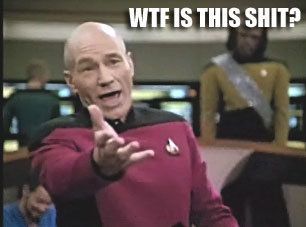
So yeah, pretty damn nerdy.
What’s weird about this is that I never really felt compelled to check out the original series. Part of that was that I don’t think it was airing in syndication on any of the channels I received at the time, or at least, nowhere that was convenient for me. My ten-year-old brain was wired kind of weirdly. I’d religiously plunk myself down in front of the TV right after school and watch cartoons, old sitcoms, and TNG, but I rarely felt compelled to watch in the evening.
Until, of course, I twigged to the fact that there were actual NEW EPISODES of TNG airing later in the evening (along with some other shows, like that “Simpsons” thing my VCR-obsessed family friend used to show me whenever I came over). I had discovered…Prime Time.
(Look, I’ve lived a very boring life, OK? Without exaggerated pomposity my autobiography’s going to be basically unreadable.)
Friday nights at 10, the night that TNG aired, became appointment television for me and my family—because I of course sucked them into it too. I’m always a little amazed at how my sisters, especially, picked up my pop cultural obsessions, for all that they acted like I was annoying them at the time; one of them can still remember albums worth of Weird Al lyrics, and the other owns an enormous prestige hardcover collection of Sandman and V For Vendetta. I’m contagious!
As for my parents, my dad likes anything tech-heavy, and my mom (a British ex-pat) likes watching theatrically trained Brit actors go at it. Of course my dad especially couldn’t help making snarky remarks through some of the show’s worst excesses, particularly the often stiff acting, but hey, family bonding is family bonding.
Oddly, it was around the time that Deep Space Nine spun off that I started to sour on Trek. Believe it or not, DS9 is the reason I’m delving into this whole subject, which is going to take up several blog posts—I’ve been working my way through it recently—but at the time, I found myself developing an aversion to it pretty fast, despite the slick production values. Part of it might be that I couldn’t interest the rest of my family in it, so I was watching it alone for season two. But another part of it was that that obsessive childhood brain of mine—man, this is really making me sound like I have OCD or something, isn’t it?—had fixated on what I thought were the “rules” of Trek, and DS9 was starting to break those rules. You can’t really blame me; this obsession with Trek was partly about me discovering how stories were told, visually and textually, and of course there’s no-one who gloms onto formulas like a student adrift in the vast, scary sea of creativity. But at the time it seemed like a betrayal. More on that anon.
Anyway, this was actually pretty small potatoes, if interesting in retrospect; the real issue was that the cracks were starting to show in TNG for me. The laziness of their treatment of aliens was a huge factor, for a start. I’m not just talking about the lameness of those infamous “bumpy forehead” designs (which were partly a budget issue, after all—even as a kid I understood these guys didn’t have George Lucas’s budget). It was the way the word “alien” never seemed to mean anything to the Trek writers. Aside from Klingons, Borg, and a handful of others, every alien species on this show spoke, acted, and emoted like a human being, and that’s just lame writing. It didn’t help that most of them appeared for a single episode and then vanished, never to be heard from again, which didn’t exactly help build a rich and detailed world. Likewise, the show’s continuity started to seem slapdash; I was interested in the “nodular” nature of TV storytelling at the time, but even then I thought it was a bit of a ripoff that so many major ideas could get sidelined and even abandoned. I mean are Trill people with weird foreheads or with dots down their necks I ASK YOU TREK PRODUCERS.
Ahem. I did mention that I was a nerd, right?
My list of problems with the show started to pile up until it was at least as large as the stuff I liked about it—something that’s become part of my makeup as a fan, unfortunately—but I kept watching all the way through to the finale, “All Good Things…” which I remember being really very good. And then that was that.
I think part of me knew it was in my best interests to make a clean break from Trek, and I even recall a vague sense of relief. Take this geeky burden from off me, Lord! Not that I hadn’t found new geek interests—I think The X-Files had grabbed most of my attention at the time, concurrent with Batman: The Animated Series--and those distracted me long enough to keep me from re-visiting TNG.
When I finally decided to start catching up on Trek a few years back, I made a conscious decision NOT to watch TNG, and in fact I don’t plan to ever revisit the show. I’m not the kind to wallow in nostalgia (ask me about Transformers sometime, and how my childhood love for them quickly became bemusement, leading into seething hatred thanks to the likes of Michael Bay) but Star Trek: The Next Generation seems to be the embodiment, for me, of a memory that the real thing will never be able to match.
Friday, June 15, 2012
Fourth World Fridays: Superman's Pal, Jimmy Olsen #142--"The Man From Transilvane"

As I’ve suggested in previous installments, the first few issues of The New Gods, Mister Miracle and The Forever People seem to show Kirby’s confidence and enthusiasm for the project growing at a remarkable rate, and by the time Mike Royer jumped on board as inker, Kirby really seemed to be pushing himself to a new level. However, this new seriousness with which he approached the core three books seems to contrast with his work on Superman’s Pal, Jimmy Olsen. I already mentioned that the fact that Colletta remained as inker on that book made it seem as though Kirby was treating it like a red-headed stepchild (so to speak), and this is reinforced by the fact that the Fourth World elements mostly seemed to vanish from the comic around this point, except for one major issue near the end of the run, and a series of expository backup features, which Kirby used to flesh out his world.
If I was *really* cynical, I would say that Kirby completely stopped giving a damn about SPJO altogether—but that’s not really fair, as there are still some neat story beats to come, even in this issue. Besides, Kirby not giving a damn still means plenty of crazy, stream-of-consciousness crap for us all to enjoy and mock! And the coming two-part storyline is a doozy as far as that goes…
For starters, the opening caption of Jimmy Olsen #142 features another howler of a sentence:
“Amid the strange sounds at midnight, this classic horror figure never fails to emerge and haunt our dreams with terrifying effectiveness!”
Yes. He NEVER FAILS to emerge. Every time you hear sounds at midnight, it’s immediately followed by a vampire emerging, and proceeding to haunt your dreams with terrifying effectiveness. By the way, does that description make anyone else think of Monsters, Inc.? “Sully, you’ve haunted another child’s dreams with terrifying effectiveness. You win Employee of the Month yet again.” “Thanks, chief, but I bet I can make my effectiveness at least 20% more terrifying if I work at it!”
Aaaaaaanyway.
The comics code was still in effect at this point, though it was getting a bit creaky—the very next year would see the famous Spider-man issue that ran without the Code, effectively dealing it a death-blow—so vampirism was a bit of a dodgy subject. This is why vampires are treated in such an odd, convoluted fashion in the silver and early bronze age, usually relying on some kind of pseudoscience to explain them away—but of course, no one could come up with a more convoluted or pseudoscientific explanation than Kirby!
We kick this off by witnessing a vampire emerging from the forest with a werewolf companion to menace a sleeping woman. But again, because of that pesky code, he can’t do anything as scandalous as biting her. Instead, he shoots out eyebeams that fly through the air and hit her neck, creating vampire-like puncture marks (!) Thank you, Comics Code, for protecting our nations’ youth from the sight of neck-biting, and necessitating this kind of crap.
“What has been done—is now done!! The results of it will rival the most awesome events ever recorded!” The first sentence fulfills this issue’s redundancy quotient; the second, the hyperbole quotient. Also, the first sentence fulfills this issue’s redundancy quotient.
The woman, by the way, is Morgan Edge’s secretary, Miss Conway, and the next morning, we see that Clark and Jimmy, WORLD’S MOST PATHETIC REPORTERS, are still arguing with the goddamn secretary about getting in to see Morgan Edge. That’s Clark Kent, the man who can throw planets around, stymied by a chica in a miniskirt at a desk. He can’t be bothered to take stronger action against the man who tried to kill him and blow up a secret research facility full of his friends. But to give him credit, he’ll wait in that waiting room as long as he has to! Provided the magazines aren’t too old!
Of course, Miss Conway makes for a bit of a distraction, with her increasingly chalk-white skin and the fangs she reveals when she talks. Then she faints, prompting Jimmy to lean in and Clark to swat him back with the baffling comment, “One side, diplomat!” He quickly notices the “bitemarks” and the fact that Miss Conway is suddenly no longer visible in the mirror. The caption declares that “A pattern is followed—a complete and total pattern!” A pattern terrifying in its effectiveness! And completeness! And totality!
Throughout the next few panels, Miss Conway takes on a really unnatural chalk-white complexion that seems to move over her like colour on an inkjet printer. “The total pattern must remain fixed!!” continue the captions, growing more and more incoherent as the sequence grows on. Basically, what Kirby’s trying to say is that he knows what a bunch of horror movie clichés all these story beats are, but just stick with him, there’s an explanation. (And there is, and man…you’re going to have to see it to believe that the human mind could come up with something so insane.)
Anyway, in keeping with the total pattern, a bat flies in and transforms himself into a pale, cape-wrapped figure who introduces himself as “Count Dragorin of Transilvane”. (At this point, I’m wondering if the makers of The Rocky Horror Picture Show derived some inspiration from this comic.) “I regret the intrusion upon your many activities in this place,” sneers the Count. I love how sarcastic that sounds, like he doesn’t quite believe Clark and Jimmy actually do anything at the Planet. That’s very perceptive of you, Count.
This recap is going to balloon to Russian novel-length if I quote and deconstruct all the bizarre, nonsensical dialogue, so I’ll just say that Dragorin insists he’s in a hurry, and continues to do so while making no move to do anything. Meanwhile, Jimmy spouts a lot of random phrases like “I second Clark’s motion!” and Clark tries asking him politely if he wouldn’t mind restoring Miss Conway from her cursed eternal unrest. Dragorin responds by zapping him with the Evil Eye, which literally sends them flying back in a burst of light.
Jimmy is knocked unconscious, but as Clark thinks to himself, “I have more effective protection! It’s called Superman!” As the colouring takes on an eerie greenish hue, Dragorin causes Miss Conway to rise and begin delivering details about her former employer, Dabney Donovan. Her only real bit of advice is to check Nasa’s Science Research Center, where, it seems, Dabney was Researching Science. Clark takes advantage of the Count’s moment of distraction to leap on him, but he vanishes in the classic puff of smoke. As Jimmy and Miss Conway come round (Conway suddenly cured of her vampirism), Clark assures them he “got a lead on” the Count “before he bugged out.” I guess that’s how Clark gets all his leads: by feigning unconsciousness until a vampire soliloquizes about something. No wonder he’s such an ace reporter.
After bundling Miss Conway off to “the clinic” off-panel—gee, that doesn’t sound creepy at all—Clark and Jimmy head out to the Science Research Center, where Science is Researched. There they find a door ajar, and inside, waiting for them, is Dragorin’s briefly-seen henchman Lupek, a werewolf. Ish. Thing. He attacks Clark and puts him down for the count, or at least he does as far as Jimmy knows. Credit where credit is due: our red-headed, freckle-faced pal shows he’s got courage by pulling up a steel fence post and using it to keep the lycanthrope away from his supine friend. Lupek chases him away down the corridor, giving Clark time to change into Superman and come to his rescue. “Superman, I’m your fan for life!” declares Jimmy. Yes, Jimmy, that is the role you play in the series. You don’t need to spell it out for us at random intervals.
Dragorin suddenly materializes, blasts Jimmy and Supes again with his Evil Eye, and disappears with his henchman. Handy, that. But while Superman and Jimmy ransack the abandoned Science Research Center and all of its Science Research for clues, Superman comes up with an odd theory to explain Dragorin’s disappearances: “Suppose they became smaller!! Too small to see!” Yes, um, that makes more sense than him being an actual supernatural entity, alright.
Superman also explains away Clark’s absence by saying he sent him back to town for medical help. Dabney Donovan, meanwhile, he describes as “the closest thing to a mad scientist we have! Well, I guess wild would be a better word!” He seems to be vaguely connected with the Project in some way, though he doesn’t explain how. He and Jimmy then proceed to make a series of rather, um, creative logical leaps: first, that the picture of a green orb with horns on the wall is a picture of planet Transilvane; then that there’s a message implanted on the picture that Supes can read with his microvision, which turns out to be correct. The message reads “Bloodmoor destruct date 1971”, which points them towards, you guessed it, an old cemetery of that name.
Meanwhile! We pick up with the Newsboy Legion, who as you may recall had snuck out of The Project and were boating down an underground river. Predictably, this has Flippa Dippa practically orgasming in delight. Because he enjoys water, don’t you know. Reaching the end of their underground tunnel, Flippa dives in and discovers an exit with an elevator at the end. By an absolutely astounding coincidence, this just happens to lead them to a secret room being used by an operative of Intergang—and not just any operative. This particular guy just happens to be yelling into the phone at the exact moment the Newsboys emerge behind him, identifying himself as the man who killed Jim Harper.
That’s the original Jim Harper, of course—the one who would have been an old man by now. His death was, you’ll recall, mentioned passingly several issues back. Apparently the presence of the new Guardian has both taken the heat off this guy and made his Intergang masters displeased, since they now assume he failed to kill Harper. (Somehow, these guys know Harper was the Guardian. Bang-up job protecting your secret identity, Jim…) Anyway, the last panel of this sequence shows the Newsboys roiling with anger as they realize they’re confronting the man who killed their…parent’s guardian. Who I’m sure they felt a great deal of affection for, and all, but honestly it seems like Kirby forgot these aren’t the original Newsboys, and thus, probably weren’t as emotionally attached as their dads would have been…
Nevertheless, “The drama of life begins to mount in many quarters!!” as the endlessly hilarious captions inform us. We transition to Superman and Jimmy landing in Bloodmoor, as Superman continues to opine that they’re not facing real monsters. “I wish we’d waited for Clark!” Mutters Jimmy. “He’d get facts!--Not opinions!” Yes, solid facts like “I somehow got a lead on that vampire in the three milliseconds before he evaporated! Don’t question me, just go!”
As they approach the mausoleum, Jimmy is hung up on the idea that they’ve found the vampire’s coffin, and Superman continues to be skeptical, theorizing that the huge slab blocking the door could be circumvented by growing very small. “Think small!” He says to Jimmy. “Like Dabney Donovan—who undertook to simulate cosmic matter in small terms! Small continents! Oceans! Life! In short--a small planet! Welcome to Transilvane, Jimmy! and at that moment, they descend the stairs and witness…
Well, words can’t do it justice.

Yes. Transilvane is a tiny planet, hovering in fog, surrounded by holographic projections, in the basement of a mausoleum, in a graveyard.
And believe it or not, that’s not the craziest thing about this scenario, as we’ll discover in the next chapter…
Friday, April 6, 2012
Fourth World Fridays: The New Gods #5--"Spawn!"

It’s not an exaggeration to say that this issue of “New Gods” is monumental. And that’s being quite literal—we both begin and end the issue with gigantic splash shots of titanic creatures, and in between there’s as much Kirby Bigness as you could ask for. But perhaps the most monumental aspect of this comic is the change in the art. This issue introduces a new inker, Mike Royer, who replaced Vince Colletta on most of the Fourth World books at this time.
Colletta’s a bit of a flashpoint for comics afficianados. He inked a sizable chunk of Kirby’s stuff during his glory years at Marvel in the 60s—possibly more than anyone else. I can’t verify that, but it’s clear he did several of the crucial issues of Fantastic Four (including the legendary Galactus trilogy and the wedding of Reed and Sue) and most of his run on Thor, and as such, is inextricably associated with that classic Marvel work. Which makes it a shame that he wasn’t actually very good.
Now I readily admit to not being the greatest artist in the world, and the question has been debated ad nauseum amongst the leading lights of the industry. Some feel that Colletta’s work, which was undeniably competent, has gotten far too much of a bad rap over the years. But speaking personally, I find Royer’s work to be far more pleasing to the eye—there’s more line variance, energy, and detail. The latter is hardly surprising, since Colletta was apparently notorious for erasing details of the pencils that he was in too much of a hurry to ink (like Kirby, Colletta was ludicrously productive). Exactly to what degree Kirby wanted Colletta on board the Fourth World is up for debate; clearly he valued loyalty and was happy to keep the team together, but at the same time, Royer was apparently Kirby’s first choice for purely geographic reasons (he was in California, like Jack, and Colletta was in New York). The details of why Colletta was replaced (he stayed on Jimmy Olsen, which it’s now safe to say was the Fourth World book Kirby cared the least about) are a muddle—some say it was a falling out, others say his assistants encouraged the notoriously nonconfrontational Kirby to take charge of his own work—but when the dust had settled, Royer was in. And it most certainly made a difference.
At any rate, this issue of The New Gods begins, like so many others, with Metron, roaming the cut-and-paste montage galaxy in his Mobius Chair, because, as the narrative captions inform us, “this point in the saga of the great Celestials…can’t be told--outside the context of the larger tapestry—the universe!” Well, that certainly is a large tapestry, alright. I’m glad not every story requires an epic, cosmic prologue like this. “Call me Ishmael. I am the product of billions of years of evolution on a tiny speck of a planet in a galaxy called the milky way…” “It was the best of times, it was the worst of times, notwithstanding the Big Bang, a cosmic maelstrom that gave birth to the universe…” Man, I’m already exhausted.
Today’s installment of Metron Presents: Our Crazy Universe takes place in “The Promethean Galaxy”, where a gigantic green dude, “larger than a star cluster”, floats bound to a gigantic slab. Apparently he and his pals tried to penetrate the Final Barrier at the edge of the Universe, beyond which is The Source; their strategy was to enlarge their atomic structure to such a size that they would…um…outgrow the Universe? Yikes. Kirby’s Kosmology has a way of making my head hurt. Anyway, they ended up slowing down their own subjective time and now float nearly motionless, taking “a billion Earth years to feel one heartbeat!!” It’s not really clear, but Kirby seems to imply that Metron had been planning on risking the final barrier himself, but seeing the fate of the Prometheans changes his mind and heads back to New Genesis, to the place where the Source makes contact with the New Gods through High-Father’s Staff.
Hey…is that an allegory for religion vs. science? You know, I think it might be!
Anyway, time to go back to Earth and catch up on the fallout from the previous issue. As you may recall, Orion had attained a bunch of Earthly disciples who he quickly transformed into a street gang. None of that namby-pamby healing the sick or preaching the eternal love of the divine for Orion, no sir! They helped Orion infiltrate Intergang, only to see him take off into the ocean for a confrontation with Darkseid’s aquatic troops, the Deep Six. Now, apparently, the police have rounded up the remaining Intergang thugs and dragged P.I. Dave Lincoln off for questioning. The sergeant is a burly bulldog of a man named Terrible Turpin, who will be stealing the show in a few issue’s time; for now, he lets Lincoln know something fishy’s going on and turns him loose. Meanwhile, after a brief burst of competence last issue, the rest of the O’Ryan Mob has been sitting around uselessly in Lincoln’s apartment, cleaning out his refrigerator, tracking dirt all over the place, and watching movies on pay-per-view. Lincoln shows up, and they all clear out…except Claudia Shane, who pointedly sticks around. She and Lincoln are doubtless swapping spit the instant we cut away.
And cut away we do, to Orion…who’s rather ignominiously managed to get his foot stuck in a clam.
Seriously.
OK, OK, it’s a mutant clam. What happened is, see, the leader of the Deep Six, an amphibian-like fellow name of Slig, used his touch to mutate it into a monster killer clam, and it’s now entrapped Orion in his underground, cavernous lair. Yes, Slig can mutate stuff just by touching it with his right hand, as he demonstrates by turning a nearby crustacean into a weird kind of dragon-thing:

Then he kills it with his other hand, which can explode things.
Orion watches all this in shock, even though you’d think he’d know all this already, if he knew who Slig was. Slig, in classic comic book villain fashion, is enough of an egotist that seeing Orion humbled is enough to get him to leave the room without killing him. Jackass.
Naturally, Orion has a way out—he can channel the Astro-Force into an emergency blast through his wristband. The clam lets him go and, in a sequence that really shows off the energy Royer brings to Kirby’s work, rears up, revealing an elongated trunk that “draws energy deep in the bowels of the Earth”, to do battle with Orion. Orion blasts the thing to Clam Heaven, then takes out a sentient shark-man standing guard and stumbles into a huge cavern, where a vast harness lies empty. This is some nice foreshadowing—Orion remembers glimpsing something huge, something monstrous, in that harness before the lights went out last issue, and Slig verifies that they have indeed unleashed something horrifying on the seas of Earth. That would be the titular Spawn.

Man, I can’t stop making that joke. Seriously though, there are times when I feel like everything in comics for the last 30 years has come from people just flipping through Kirby’s work, picking out random elements, and expanding on them.
Back on the surface, Terrible Turpin has indeed twigged to what’s going on by interrogating an officer of his, bandaged from head to foot after an apparent encounter with the forces of Apokalips. I have no idea who this guy is, and I don’t think we’ve seen him before. Apparently the idea is just that the war of the New Gods is raging all over the place now, and regular folks are getting caught up in it as well. But it comes off as the ravings of a guy who just went through severe physical and mental trauma, being taken with utmost seriousness by his dour police chief. “A gang war!!--between super-spooks!!” Turpin muses, thoughtfully. When another officer puts down the guy’s testimony as “sounding like a UFO sighting”, Turpin employs his impeccable logic:

Uh…huh.
Anyway, we cut back to Claudia and Dave, lying in bed, smoking cigarettes—
Ha ha! Just kidding. This is the era of the comics code. They’re fully dressed and staring at the window. But to anyone who doubts these two are going at it hot and heavy, I’d like you to please explain what they’ve they been doing all this time? Playing Pachinko? It’s not like they actually have anything to contribute to Orion’s efforts other than to sit around worrying.
At least it’s well-founded worrying, as we soon see. The thunder outside roils and crackles and transforms into the shape of a Boom Tube, which spews forth an old buddy of ours: Kalibak the Cruel, now dressed to the nines in a spiffy green centurion suit. His first act, of course, is to start smashing stuff. Again, Royer really takes Kirby’s work to a new level in this sequence, which is also enhanced by Kirby’s strong storytelling. I love how we glimpsed most of these characters knocking around in the first issue, and now they’re showing up on Earth one by one. “The New Gods” really is the most coherent, narratively tight comic Kirby ever did.
Meanwhile, back in the actual plot, Slig has discovered the trail of incapacitated (dead?) guards leading from the cavern where Orion had been. I didn’t mention it before, but there was a couple of panels on a previous page where Orion was running through the tunnels, homing in on his equipment, and you see him carrying on an inner monologue, checking his wrist monitor, and looking pensive while casually putting the beat-down on an amphibian-monster with one hand. Orion is hardcore. Don’t believe me? Watch what happens next.
Slig bursts in just as Orion is strapping on his Astro-Force equipment. “Allowing you to live was a mistake, Orion!!!” Growls Slig. Um, yes, I would say so. Orion takes the opportunity to blast Slig from point blank range, and then, when that doesn’t finish him off, we get one of the greatest sequences in the history of comics. And no, that’s not my usual sarcasm.
Slig weakly protests his defiance, and Orion starts laughing like a madman, drops his equipment, and runs forward to start pounding Slig to death with his bare hands. “Talk, Slig, talk!! You seemed so fondof it when I seemed to be at your mercy!!!...You dogs of Apokalips are eloquent when destiny favors you!!!” With that, he rips off Slig’s headdress, revealing his Mother Box, and crushes it until it self-destructs to stop the pain.

Slig still stirs, weakly insisting “I’ll kill you for the sham you are!!--” (What?) In the heat of the fight, Orion’s face has gone from his pretty-boy visage to the ugly mug we glimpsed in the second issue, which the dying Slig sneers at—“HAHAHA!! ORION IS HIS VERY OWN MONSTER!! HAHAHA!!”—and prophecies that, even if he can’t kill Orion, his penchant for destruction will catch up with him eventually. Orion pretty much shrugs and says “Yeah, OK,” and then pitches Slig off a cliff to his death.
So after several issues of telling us how Orion was an out-of-control violent maniac who rejoiced in battle, we actually get to see it. Kirby’s development as a storyteller in a mere few issues is pretty astounding. Also, that was the awesomest thing ever.
And with a mere two pages to go, Kirby and Royer still keep the awesomeness coming, ending with that final shot of a Leviathan I mentioned earlier. Orion rockets out into the ocean to confront the monster Slig turned loose on the world, and here we finally see it in the final splash page: A GIANT PINK WHALE!!! WITH TUSKS!!!!
(Seriously, it looks cool when Kirby draws it.)
Thursday, April 5, 2012
Pop Culture Will Eat Itself
I haven’t been making much use of this blog lately, and it’s not because I don’t want to—just the opposite. I keep coming up with ever more elaborate and baroque ideas for blog essays, many of them part of a putative in-depth series, but my problem is that I never want to launch into them without getting my ideas organized first. Clearly this is leading to literary paralysis, so I’ve decided to just launch into a post, or series of posts, and let it develop as it comes. All of this is to say, if the following seems somewhat on the vague side, you may understand why.
Aaaaaanyway.
Being a geek on the internet, I can’t help but notice the contentious tone that’s settled into fandoms of various stripes. (Thank you, doctor obvious.) I choose to stay away from the more sordid corners of the net and cleave to the more intelligent and thoughtful writers on pop culture, but that doesn’t mean I’m more likely to avoid contentiousness. Just the opposite, in fact. Some of the smartest and most insightful bloggers in geekdom, or any subdomain thereof, have (often delightfully) acid tongues. But there’s an interesting attitude that’s been forming for a while now among the nerd literati—the desire to inject some much-needed self-awareness into the culture of geekdom through criticism. There’s no getting around the fact that the more ravening segments of fandom have gotten out of control, feeding a sense of entitlement grown ludicrously bloated (see, for example, the petition or whatever it was to change the ending of Mass Effect 3) and bizarre tribalism centered around serving the finances of huge corporations (here see the decision by many geeks to side with Marvel against the Kirby heirs, or, slightly less toxically, the caterwauling over The Dark Knight’s failure to win Best Picture or beat Titanic at the box office.) And of course, it’s become de rigeur for nerds to reject considered criticism of their Favourite Thing as a mortal insult that cannot be allowed to stand, leading to an unfortunate watering down of serious analytical reviews. In the face of all this, an attitude of contempt and disdain towards geekdom is not only understandable but often laudable.
And yet.
A knee-jerk attitude from an intelligent contrarian standing against mindless groupthink is nevertheless a knee-jerk attitude, and I feel like we’re starting to see some negative blowback. Essentially, there’s an ultra-defensive elitist mindset forming that seems to feel they can take it for granted that [pop culture property X] is a waste of time propagated by the dregs of the net, and that anyone who speaks up in its defense is by default an unwashed, unselfaware nerd. This is the “Oh, now a bunch of NERDS are gonna complain that I dissed Arkham Asylum” response, and it seems to tilt perilously close to shutting down debate just as the rabid hordes of fanboyism do. If you post your thoughts on the internet, you’re likely to find people disagreeing with you; that’s sort of the point of the internet.
But I didn’t really want to talk about the Great Nerd Wars in particular, I wanted to investigate a particular aspect of this attitude: namely, the way some pop culture properties are elevated above others, both in the short term and the long term.
Here is a list of things:
--Lord of the Rings.
--Mass Effect.
--Marvel Comics.
--DC Comics.
--Watchmen.
--Scott Pilgrim.
--Firefly.
--Game of Thrones.
--The Wire.
--Star Trek.
--Doctor Who.
--Star Wars.
--The Prisoner.
--My Little Pony.
--Rap music.
--They Might Be Giants.
--The Beatles.
--The Coen Brothers.
--David Cronenberg.
--Joss Whedon.
--Rob Zombie.
--The Boston Red Sox.
I’m guessing that you see that as a pretty varied list—I don’t just mean your personal likes and dislikes, I mean that these all seem to occupy wildly different places in the pop cultural sphere. Some of them are “classics”, part of the canon of the 20th or earlier 21st century, and some of them are trash culture or ephemeral entertainments, and some fall somewhere in between. I bet your mind sorted them out to an almost subconscious degree. And yet, all of these are the subject of passionate pop cultural fandoms—what we’ve collectively decided to refer to as “geekdom”. Some of these aren’t thought of as “geeky” per se, and yet the passion they engender seems very much of the same quality. And to a degree, it’s rather surprising that we separate them in this way.
Please understand, I am NOT trying to make an argument that everything’s subjective, as a springboard to excusing my own taste’s or anyone’s. This might seem like the first step down the path towards the argument that Citizen Kane and The Transformers Movie are both equally valid works of art*, and that isn’t my intention. I’m just saying that these properties all have essentially the same qualities, in the scientific sense; they’re all, fundamentally, the same kind of thing. So why are some easily dismissable and require a burden of proof from anyone trying to argue in their favour, while others demand to be taken seriously, even by their detractors?
Look at Lord of the Rings, which is the one thing on this list that could potentially escape this little Pop Culture Ghetto I’ve devised. (And I think “ghetto” is precisely the wrong word for it, but let’s leave it for now.) LOTR was written as a sideline, a hobby of sorts, by a literary professor with a day job. It was his life’s work, and it was produced as an artistic statement rather than an attempt to make money or win an audience**, and it’s had a significant literary impact; it wouldn’t be unreasonable to elevate it to the position of “literature”. But it’s a work of pop culture, too, one whose fanbase and impact are very much in the same mode as all the others on this list, if perhaps more literate and thoughtful than the average Rob Zombie fan.
…And see, there I go—knee, jerking away. The fact that I personally find Tolkien’s work to be more deserving of merit than Mr. Zombie’s oeuvre doesn’t mean that I somehow “outrank” them. Or that LOTR doesn’t occupy the same nerdosphere. I know for a fact there are supremely intelligent horror fans out there who have elegant arguments in favour of The Devil’s Rejects, and I know just as surely that there are some awful dimwits out there who love LOTR and think that that alone makes them discriminating and classy.
“Classy”. That might be a useful word for this discussion.
I actually don’t want to dwell too much on Tolkien, because he’s something I’ve been wanting to blog about in depth and I’ll probably have lots to say in another series of posts, but for now my question is this: If Tolkien had come along a decade or two later, would we be as quick to elevate him above stuff like Star Trek? That’s not a knock on Tolkien so much as it is an elevation of everything else; after all, Star Trek was an intelligent, ambitious show. But it also shares with Tolkien, and the rest of my little canon there, a world of arcane details to which the fans have developed an attachment beyond mere entertainment. They even share made-up languages that have spawned real-world speakers.
Let’s move on to something closer to the other end of the scale, or rather two things: Doctor Who and old Superhero comics. These are two properties to which my exposure was limited as a kid, but in which I began to take an interest as an adult partly because they have so many intelligent defenders, particularly on the web. Neither of them escapes being seen as a “nerdy” pursuit by the mainstream, or as silly or inaccessible to outsiders, and yet, within geekdom, both are taken relatively seriously. There’s an underlying belief that there are fundamentally interesting and intelligent stories to be told by these properties, and the people who blog passionately about them are able to articulate these arguments more than most fandoms. They are, to return to the word, “classy”, in a way that 80s cartoons and video games aren’t. And yet, it’s often hard to argue for the merits of a given Silver Age comic or an early-80s episode of Who, which are not only frequently threadbare or slapdash, they’re often outright nonsensical. Even stupid. And it’s not like the defenders of these two properties will argue otherwise. So what makes these particular pop cultural emanations “classier” than others?
To be continued….
*Well, I’m not going to refuse to entertain such an argument if it’s well-reasoned enough, but that would have to be one hell of an argument. “They both have Orson Welles in them” might not be the place to start.
**Probably a drastic oversimplification, but it’s surely not unfair to say that Tolkien wasn’t really dreaming of tearing up the paperback bestsellers list, right?
Sunday, April 1, 2012
Game of Thrones Day
Having now seen the whole first season three times...(SPOILERS, obviously. If you haven't seen it yet, what the hell are you waiting for?)
THINGS THAT ARE BAD
--Dany's relationship with Khal Drogo. For all the nice bits of characterization that the showrunners lent to many of the characters, this business in the first couple of episodes felt like they were going down a plot checklist, and of course there was the dubious wedding night scene that makes Dany seem like a victim of Stockholm Syndrome. They also missed a nice chance at a reversal--I feel like we should have been watching Viserys and expecting HIM to be the important character, so it's more of a shock when he gets kacked.
--The Dothraki in general were treated a bit too much as Noble Savages, except without the "noble" part. We sort of came around to them by the end of the season, but for large stretches in the early going, you half expected them to pop Dany into a cartoonish cast-iron pot and try to eat her, the racial stereotyping was so unsubtle.
--The lack or mishandling of the dream sequences, and magic and supernatural in general. I realize part of the appeal of this show is that it's "grounded" and doesn't have people tossing fireballs at each other or fighting krakens all the time, but it's still a fantasy show, and in the books, when magic DOES show up, Martin handles it amazingly. Here, with one exception, everything remotely supernatural is stripped of its poetry or impact--it's back to the aforementioned checklist. Particularly disappointing is Mirri Maaz Duur's healing of Khal Drogo, which for some reason takes place in broad daylight, without the awesome visual of horrific shadows dancing on the tent wall (how much would that effect have cost? Seriously!) and with everyone just treating her use of magic with a shrug or, at worst, mild disdain. Dany's sudden "oh, can you do some magic?" was a particularly huge gaffe, because she's never supposed to have seen anything like that in her life. Ditto the White Walkers' attack on Commander Mormont late in the season--that at least had a nice horror-movie vibe, but it was too perfunctory, and the Night's Watch in general seems too comfortable with the idea of the supernatural. Even if they are on the bleeding edge of Westeros, they really ought to be as surprised as anyone that the dead might suddenly spring back to life. There's too much Harry Potter syndrome here, where magic is something you can take for granted. That can be powerful in other fantasy stories, but here it's supposed to be something wild and terrifying.
--Aiden Gillen, the one cast member I find unconvincing. His performance is mannered and kind of bizarre; not for a second would I trust him, making his heel turn kind of a "well, DUH" moment. It reminded me of Zack Snyder's moronic Watchmen adaptation, where he all but holds up a sign pointing at Adrian Veidt screaming "THIS DUDE'S EVIL!!!" which kind of makes the whole mystery aspect pointless. GoT wasn't as bad as all that, but why waste an opportunity to keep the audience guessing?
THINGS THAT ARE DUBIOUS
--Ned the chowderhead. Obviously he's not supposed to be the sharpest tool in the drawer, but D&D really make him seem like a complete cretin at a few points, and Bean's slack-jawed performance doesn't help. Not saying I didn't like Bean in general, but there's a few scenes where he comes off as borderline stoned. Particularly dodgy is the first part of the scene where he strips The Mountain of his titles, where Littlefinger exposits at him like a developmently disabled child, and the bit where he twigs to Joffrey's parentage.
--Everybody Hates Theon. There's obviously a need for Theon to feel a bit resentful towards the Starks, since he's a more sympathetic character in the show than the book (I'll say no more for people who haven't read them). But they do it by having basically everyone treat Theon like a dick for no reason, including and particularly his adopted brother Robb.
--The underpopulated Dothraki horde and tournament, plus battles that egregiously take place offscreen. This is obviously a budget thing (and yes, the battles were mostly offstage in the books, too), so I give it a bit of a pass, but it's still a bit ridiculous to see Tyrion conveniently knocked unconscious right as the fight starts.
--The direwolves. I give this a pass because I know there was a lot of behind-the-scenes turmoil with the dogs, and budget issues. Still, it's a shame we didn't see more of them.
--Ros. Nuff said.
THINGS THAT ARE GOOD
--That amazing cold open (literally cold, in this case), the one exception to the whole "mishandling the supernatural" thing. Set up too high a set of expectations for the later White Walkers to live up to, though I'm sure they'll correct this in the coming seasons.
--Turning minor characters into awesome supporting players. Bronn is the all-star superpro here--he was a complete cypher in the books, part of the scenery, but I'm guessing he's a lot of people's favourite character in the show. Slightly more important in the book but still elevated hugely by the actors: Shae, Varys, Barristan, Renly, Yoren, Gendry, and Viserys.
--The entire cast, really, aside from Gillen. Just an entire world of awesome characters here--someone said in a forum that this is one of the few shows with lots of sprawling storylines where you're never disappointed when they cut back to a particular set of characters, and I agree.
--With special props to Peter Dinklage, of course.
--And Maisie Williams. Obviously Arya's an important character in the books, but Williams leaps out of the screen and demands attention. Even more so than Dinklage, who was handed a great character to begin with, Williams makes Arya one of the stars of the show in a way I'd argue she wasn't in the books.
--Making the Lannisters more sympathetic out of the gate. Except Joffrey, who they've delightfully cranked up to eleven on the Douchebag Scale.
--New scenes with King Robert. Mark Addy knocked them out of the park, and made his otherwise somewhat abrupt death seem like a sad inevitability.
--Pretty much everything I haven't mentioned yet.
On the whole, a somewhat uneven first season that shows signs of being rushed...and yet still a compulsively addicting piece of television, with every sign that it's going to improve vastly from here.
Subscribe to:
Posts (Atom)