Friday, January 18, 2013

Fourth World Fridays: Superman's Pal, Jimmy Olsen #144--"A Big Thing In A Deep Scottish Lake!"


Word to the wise: if you don’t like Scottish accents, bail out now. You’re about to be subjected to the worst Scottish accents this side of Kevin Costner in Robin Hood: Prince of Thieves. And for those of you saying, “But Adam, Costner was supposed to be doing an English accent,” I say--exactly.

This issue is credited to “Jock Kirrbie”, for crying out loud. And the opening splash features a dude in a speedboat, racing along the black waters of a certain well-known Scottish lake, yelling “Come out, y’beastie!! If y’rr truly doon therrr, Ian MacGregor would like a look at ye!!” Well, you have to admire Kirby’s restraint in not naming the character “Scotchy MacTartan”. By the way, I love how this guy thinks that, after remaining a mystery for decades if not centuries, he’s going to expose this Monster by blasting around in a speedboat and yelling at it.

Well, apparently, it’s a more effective tactic than you might think, because moments later, … something rears out of the water, smashing the boat to kindling. MacGregor escapes to tell the tale to the newspapers, which of course he does, since, as Kirby informs us, “No Scotsman will remain silent when his boat is wrecked!!” Um, I’m pretty sure that holds true for most nationalities, Jack. It’s not like those Kurds or Norwegians or Laotians are known for building an impenetrable wall of silence around their accidental boat-wreckings.

At any rate, I’m assuming Kirby’s coyness has been to no avail, and that everyone reading this has long since guessed what we’re dealing with here. I’m not sure why he even bothered to try and make it a surprise, I mean, hasn’t everyone heard of the world famous Loch Trevor Monster?...

…Wait, what? Must be a misprint. Moving on.

At any rate, Jimmy and the Newsboys are attempting their monthly confrontation with Morgan Edge over his attempts to, y’know, blow them up. I don’t understand why they’re not making more headway with this—I mean, their strategy is to march into his office and loudly accuse him of putting a bomb in their Whiz Wagon. Edge is too crafty for them, though—he (get this) denies everything. This puts an unexpected crimp in the master journalists’ plans. What’s a crimesolver to do when the suspect won’t just voluntarily confess the moment you confront him? It’s clearly stalemated the Newsboy Legion, but Morgan Edge outdoes them again by suggesting a new assignment. “I could assign you to follow up this new fish story--and--” “Fish story?” jumps in Flippa Dippa. “You mean fish—like in water??” Oh Lord, he’s off on that again. Amusingly, even Jimmy seems to be getting sick of him:


Well, at least Flippa has a forceful personality, because all the other Newsboys immediately fall into line on this dubious assignment granted them by a man who tries to kill them every time he sends them to cover a story. What makes it all the worse is how clearly sensationalistic and tabloid-esque the assignments he sends them on are. I could accredit this to a very subtle bit of satire on Kirby’s part, with Edge buying up the Daily Planet and turning it into a yellow rag, a la Rupert Murdoch. But then I’m forced to remember the kinds of non-stories the Planet generally covered before Edge bought them out—vital stories like “Jimmy Olsen receives medal” and “An interview with Superman, by Lois Lane, part 72856 of a series,” and I have to wonder if Edge hasn’t actually classed the joint up somewhat.

Besides, as is not hard to figure out, “tabloid journalism” in the DC Universe is a whole other ballgame, since alien love babies, werewolves, demonic entities, and other such folderol actually exist. In the DC Universe, the Weekly World News and the National Enquirer would be vital, respected publications, a point Grant Morrison made in his recent “Manhattan Guardian” miniseries, part of the Seven Soldiers project. Hey, and that story featured the Newsboy Legion as well. And Grant Morrison is Scottish!!! IT’S ALL FALLING INTO PLACE!!!

I don’t need to mention that Morgan Edge gets in touch with another Intergang operative the minute Jimmy and company have left the room and orders them killed again, do I? I assume not.

But where’s Superman? Why couldn’t he be bothered to provide backup for Jimmy’s confrontation with Edge? For a very good reason: he’s been invited to a discotheque.

Yes, in an odd attempt to drum up publicity, Terry Dean—the odd not-Lois Lane character who’s been popping up for a panel or two here and there—has invited Superman (and the Guardian, for good measure) to the opening of a new nightclub, where he’s immediately bombarded by autograph seekers and made to feel uncomfortable as “a charter member of the establishment”. Hmmm, I was going to ask why no one had ever thought to invite Superman to an event like this before, but I guess there’s your answer. By the way, I think it’s safe to say that Kirby was never in a discotheque in his life, judging by his odd portrayal of same: basically, it’s a mash-up of counterculture elements from many different eras, hippie, beatnik, and, um, seventies. In particular, the house band resembles a demented version of the Partridge Family—and “demented” may be the right word, as they immediately make it clear that they’re working for Darkseid and are concerned that Superman’s going to wreck everything.

As if this wasn’t enough, Dubbilex suddenly shows up. Remember Dubbilex? He’s the long-suffering, purple, horned mutant that The Project bred as a sideshow attraction, or something. He’s here to inform Superman about some suspicious goings-on that relate to The Project. Superman looks relieved at having an excuse not to have to do any disco dancing. You and me both, Kal.

Meanwhile, SHENANIGANS! As the Newsboy Legion is whisked to Scotland in, apparently, Edge’s own private Lear Jet. Scrapper dresses up in a full tartan outfit, complete with kilt, and they all pile into the Whiz Wagon, which is dumped out at Loch Trevor.

Son of a…yes, Loch Trevor. Not Loch Ness. They’re here to uncover the mystery of the Loch Trevor Monster.

It’s often hard to tell what Kirby was thinking when he made decisions like this. I doubt that Kirby was so skeptical about Nessie that he invented an entirely new creature—I mean, even if he was a skeptic in real life, the guy just finished a storyline about vampires and wolfmen who came from a microscopic planet. I do know that the citizens of Loch Ness are very, very protective of their “pet monster” and don’t like seeing it portrayed as smashing boats and eating people; it could be that Kirby got wind of this and decided to respect their wishes by moving the monster to a different Scottish Loch. Everyone knows that the Loch Trevorites are a bunch of jerks anyway, so they deserve to have a nasty monster.

Anyway, on landing, they almost manage to run over their contact, a cartoonish Scotsman by the name of Felix MacFinney. Naturally the dialogue that follows is full of “rrrrr”s and “ooo”s and “bless me tartan!” and oh just kill me now.

Oh, good, let’s go back to the disco with Supes and Dubbilex. Dub reveals that he found a tunnel leading from the Project all the way to this club—what, this specific club, or just Metropolis in general?—built by someone other than the Hairies. This is the cue for the House Band, known as “The San Diego Five String Mob”, to try and rub out the heroes with the power of music. Seriously. Their instruments, when played in conjunction with a heretofore unseen sixth member named Barriboy—who pops up right behind Superman’s table—can summon, like, bad vibrations, man. Vibrations which bring the club’s ceiling crashing down.

Meanwhile, back to Scotland, where, according to the caption, “Chaos is far from the order!” I don’t know wha that means, but I don’t begrudge it this time, because our first panel is of MacFinney introducing his ultra-hot miniskirted daughter, Ginny.


I should use this opportunity to mention that I’ve been to Scotland, and even have ancestors from there, and I actually *love* Scottish accents. Real ones. Especially coming from cute girls. It’s this ridiculous comic-book approximation I find dopey. But I guess if I imagine everyone talking in the voice of Kelly MacDonald I’ll be OK. Mmm…Kelly MacDonald…

An exposition-filled dinner reveals that MacFinney has built a sonar whistle that will, apparently, call the Loch Trevor Monster to them. Gee, that’s convenient. You’ve lived in Loch Trevor for years, and you’ve just now invented a device that will help you prove the existence of the monster. Also, he calls Big Words “Big Wurrds”. Oh, and by the way, Scrapper brought that little “Scrapper Trooper” he’s been carrying around since he left the Project, apparently under the belief that it will provide a magical solution to any problems that come up.

The next day, the whole gang is out on the Loch, and Flippa Dippa is, of course, in hog heaven as he gets to make himself useful for a change. Unfortunately, just as he’s turning on his searchlight, hands reach in and grab at his air hose. The above-water Legion members lose contact, and just as they’re preparing to go in after Flippa, MacFinney seizes the opportunity to reveal himself as a turncoat. Yep, he’s working for the Scottish branch of Intergang, or as he puts it, “Interrr-gaang”, as a “Prrofishn’l killer.” So…after nearly letting himself get run over by the Whiz Wagon as it landed, he took them home, made them dinner and gave them a pleasant night’s rest, let Jimmy sleep with his daughter (I’m assuming—Olsen is a playa, after all) and loaded up his special equipment on the boat, and THEN finally decided to kill them? That’s the most ridiculously delayed hit job I’ve ever seen. This guy works for Intergang, alright.

Jimmy tries to distract MacFinney by getting him monologuing, but surprisingly, it doesn’t work. However, it does give Scrapper a chance to employ his mini-me and activate the sonar device that will summon the monster. (By the way, there’s actually a decent reason for why MacFinney would have access to a device to summon a monster that supposedly no one’s ever seen clearly; it’s revealed in the next issue. But you’d think our ace reporters might be a little suspicious.) The Lake Trevor monster does indeed come when called, trashing their boat and sending them into the water; MacFinney is apparently dragged down by the monster off-panel. The Newsboys swim to shore, bemoaning the loss of Flippa Dippa, but it turns out he’s alive and well and waiting for them. Well, I’ll be. It turns out that Flippa Dippa really is actually competent in his native element, because he was able to overcome his assailant—it’s Ginny, unsurprisingly (though, to my chagrin, she’s not actually Scottish, nor is she really MacFinney’s daughter).

The story ends rather abruptly with Jimmy swearing to stick around Scotland until he gets to the bottom of what’s going on. That’s fine by me, Jimmy. Stay in Scotland for as long as you like. It’d be nice if I didn’t have to read about it, though.

Friday, December 28, 2012

Fourth World Fridays: The New Gods #6--"The Glory Boat!!"


That's the Glory Boat, you pervs.

What, you thought I wouldn’t go there? I only have class inasmuch as it stands in the way of my making an obvious joke.

We’re now getting into the run of New Gods issues that Kirby feels was the strongest thing he ever did, and the energy is palpable. As you might recall, the last issue brought us face to face with the horrifying Leviathan the Deep Six (“Mystic Mutators of the Deep”) had unleashed on the world: a gigantic pink warthog-whale thing bigger than an oil tanker. You know how I can tell that? Because in the opening pages of this issue, the thing eats an oil tanker.

Well, it doesn’t “eat” it so much as it gores it with its tusks and that weird phallic ram-thing under its chin.


My favourite moment in this sequence: a sailor, spotting the leviathan, announces, “The closer it gets—the bigger it gets!!” He’s just discovered the magic of perspective! Also, the oil tanker, despite being specifically described as being made of steel, is coloured to look like an old-fashioned wooden sailing ship.

There’s now a montage of the Leviathan trashing ships all across the ocean, ending with a nice panel of a life saver marked “S. S. Aurora” floating empty in the water to segue to the main story. It seems that one of the vessels wrecked was a yacht owned by a wealthy industrialist named Farley Sheridan and his two children, who are now floating in a life raft in the middle of the sea. These three, who we’ll be getting to know better in a few pages, provide our “everyman” perspective on the following events, starting with Orion blasting out of the water a few meters away from them. Farley immediately jumps to the rather odd conclusion that “he’s some kind of new Navy frogman type!” Right, because navy officers are always dressing up in flamboyant, skintight clothing.

…Well, OK, but not while they’re on duty.

Orion, rather dickishly, chooses not to talk to the lost and frightened people on the raft, but first does a sweep of the area while caught up in his own expositional thoughts (basically recapping the last issue). Eventually, he does deign to lend a hand, shooting a tractor beam-ish thing to grab hold of the raft, or as he puts it, “A magnetic force will saturate your craft’s atomic structure!—And bind us as one!!” Kirby sure had a thing for the phrase “atomic structure”, didn’t he? Oh, atomic structures! Is there anything you can’t do?

Orion offers them rescue, but he points out that he’s on a dangerous mission, and that tagging along with him could result in their death. Here we get our introduction to the basic character dilemma of this issue: Farley, a WWII vet, claims that he’ll happily jump into the fray if it’ll get them off the raft, whereas his son Richard, a pacifist, is reluctant, and his daughter Lynn is basically a nonentity. (It’s an unfortunate feature of Kirby’s books that, in a given group, the woman will usually be the one most devoid of personality and least helpful…though there are a couple of major exceptions, like Barda.) Richard, meanwhile, is the one who starts to maybe get a teensy inkling that possibly, perhaps, the helmeted guy on the flying harness with the futuristic technology isn’t a naval officer.

After skimming across the ocean for a while (shown from above in another very nice panel), Orion finds what Mother Box has been leading him towards: a weirdly shaped wooden boat (actually, it’s more like a raft with a a temple-like cabin built on top) and a human-shaped figure bound in some kind of weird wrappings where the mast would be. Mother Box indicates that it’s alive.

“Well, there’s one way to strip those bonds away!-- Orion’s way! The way of the Astro-Force!!” Are you surprised? This is how Orion solves all his problems.

“Locked myself out of the car again! I’ll handle this Orion’s way! The way of the Astro-Force!” (Melts car with laser blast.)

“My microwave is broken! I’ll handle this Orion’s way! The way of the Astro-Force!” (Chars bagel to a smoking cinder.)

“America has become crippled by political partisanship! I’ll handle this Orion’s way! The way of the Astro-Force!” (Starts randomly shooting people.)

Anyway, the bandages—which turn out to be more of that malevolent mutated kelp Orion encountered a while back—come off, revealing none other than Lightray, who, it turns out, broke his promise to Highfather to join the war against Apokolips. Mere panels later, Orion declares that “Your kind brings an undeserved honor to war!” Well, someone’s honor’s undeserved, anyway. With Orion and Lightray now together, the pompous speechifying picks up. “Now—to see what demon’s swill the Deep Six have served up inside this craft!!” declares Orion, marching inside. Meanwhile, the Sheridan family introduces themselves to Lightray, with Farley making clear his sneering contempt for his son’s non-violent ways. “I’m a conscientious objector!” declares Richard, “I don’t like war, violence, or killing!!” “Is that right?” muses Lightray. Well, I know of a place where everybody’s like that!”

Hmmm…so conscientious objectors are like New Genesisians? That’s actually logical in a way, despite the amount of fighting they do—the idea seems to be that they only go to war when it’s absolutely necessary. Of course, that assumes that the magic wall that tells them what to do is always correct and good and just; somehow I think that a real-world conscientious objector would have a hard time falling into line with that.

Orion calls for Lightray, and they enter the hold to find a big, green, icky creature crouching in the corner, which they dub a “Sender” and an “organic director”. “There’s a mountainous sea beast out there, destroying ships!--And this—this is its brain!!” Um…wouldn’t a better place for its brain be, y’know, in its skull?

“It shouldn’t be destroyed!” reasons Lightray. “It should be changed!! Light! Light!--not to glisten on swordblades!—But light at play with atoms--to make them sing in other ways!!” Are you perhaps getting the sense that Orion and Lightray are allegorical characters?

Lightray transforms the critter into a “living basic life form!!” which apparently means a big cube of jell-o. There’s a lot of technobabble here, but basically they’re going to “imprint it with the image of New Genesis” and cause the leviathan to turn around and head back to the ship. Which it does, accompanied by another of the Deep Six, named Jaffar. Yes, Jaffar. Sadly, he does not own a wisecracking parrot voiced by Gilbert Gottfried. He does, however, have the ability to turn invisible and slip past the beams of light Lightray is sending down to the ocean floor in an effort to spot him. You’d think they’d know that about the guy and thus not waste their time, but…

Back on the boat, Richard is succeeding in pounding it into his dad that they may be just a tad over their heads here. By the way, I love how Orion was just casually going to let them go into battle, despite the fact that they’re regular humans, and thus would presumably be creamed by the forces of Apokolips. Well, he did give them a choice, I suppose. Nevertheless, having seen the “life cube” beginning to grow into a gigantic, bleeping machine, and “with Lynn to consider”, Farley is having second thoughts about staying. So, uh, Farley, you knew there was going to be a fight, and you were willing to risk your daughter, but as soon as weird mechanical cubes get involved, suddenly you’re determined to keep her from harm? You’re kind of a douche, Farley. This is driven home by the fact that, despite his admittance that his son is correct, he’s still getting shots in at him as a coward.

Unfortunately, a clean getaway isn’t in the cards, as Jaffar shows up to menace them. Richard starts calling for them to escape, but Farley is paralyzed with fear (as, I guess, is Lynn, but she’s barely in panel for this sequence). Richard suddenly finds himself galvanized into action and leaps forward into battle, threatening to fight Jaffar to the death to protect his family. But despite his newfound courage, this has about the same result you’d expect, i.e., none at all. Jaffar grabs him and uses his mutating touch to kill Richard by, basically, erasing his face. It’s a pretty damn creepy sequence.

Of course, now Orion shows up. Yeesh. If you knew the guy was going to return to the ship, why didn’t you just stay and protect them? Anyway, he blasts Jaffar off the ship with the Astro-Force, but Jaffar is already gloating that he’s impossible to kill in the water. So what does Orion do? He shoots him over and over again, keeping him in the air each time, until he’s exploded. Ouch.

Orion returns to the ship to find Farley babbling, lost in the delusion that his son has “joined his platoon—on the beach!! Yes--that’s it!!” And Lynn, as usual, just standing around crying. Jeez, why is she even in this story? Orion straps her into his harness and sends her up and away, out of the story to safety, even as her father refuses to leave.

Declaring Richard to be “another faceless hero!” Lightray sets him alongside the machinery in the cabin. Then, as the wind rises ominously and fish are seen streaming past, the remaining Deep Six—the Deep Four, I guess—launch their attack. The remaining Deeps are Shaligo, “the flying finback”, Trok, who has a whirling axe on a whip, Gole, who…has no special powers that I can see, and Pyron, who flies the manta ship with its flamethrowers. You wouldn’t think flamethrowers would be a huge benefit underwater, but they turn out to be useful when Orion repels the attack and Pyron sets fire to the boat.

Orion seeks to get away, but Lightray has apparently gone insane. First, he’s tied Farley to the mast (!). Then he draws Orion into the cabin, where Richard’s face has been restored—whatever—and their weapon has taken shape, even as the Leviathan and the manta-ship bear down on them.

From all accounts, Kirby claimed the next two pages to be the best things he ever did. On one side: the Deep Four, zipping alongside the vast pink monster as it rears out of the water. On the other, a bizarre missile formed from the techno-active cube, with Richard’s body lying pread-eagled on top, Lightray standing right at the tip, and Orion clinging onto the side, brandishing his fist at their oncoming foe.


It’s pretty awesome.

The two forces meet and explode, but of course Lightray is able to pull Orion from the point of contact at, y’know, lightspeed. We’re left with the image of Farley—who we’re hastily told was “backlashed far from the flaming area!!” left floating, adrift at sea, alone with his guilt that his supposedly cowardly son was able to fight when he couldn’t. (A tiny ship, visible on the horizon headed towards him, obviously implies that he’ll be rescued.)

As we’ve seen, of course, the Fourth World is full of this kind of tension, between the old and the young, between violence and non-violence, but here we have probably the purest expression of it. Kirby, as we all know, was a WWII vet himself, but he also seemed to have a lot of affection for the hippie types that presumably made up a chunk of his audience…and here we see the two types coming into conflict. The fact that the young pacifist seems to be proven to be in the right--though maybe not in a way that a real pacifist would agree with—is interesting; the point seems to be that, when the chips are down, Fairley, the war vet, is frozen in panic, whereas the pacifist leaps into the fight heroically.

This is a bit confusing. If we're meant to find irony in the fact that the two men act differently from how they behave, that's problematic because it sort of implies negative things about pacifism. That clearly wasn't Kirby's intent, and indeed, Richard is clearly the more likeable character both before AND after the battle begins and his true colours are shown, to the point where it seems like Kirby's almost pandering a little. But then, the point is apparently to praise people who "speak softly and carry a big stick". In fact, there's a fairly subtle and crucial point here being made about pacifism: it's not about cowardice or suicidal nonviolence, it's about keeping violence at a distance unless absolutely necessary, and not using it as a rhetorical club.

One thing's for sure, it's interesting that Kirby is so willing to write off the WWII vet while showing the representative of the younger generation in a more positive light. This is a theme the Fourth World comes back to again and again, a reverent awe for the flower power generation, which carries a lot more weight coming from someone who wasn't actually part of that generation. It's perhaps not hard to see how the Baby Boomers ended up with such high opinions of themselves.

Saturday, December 22, 2012

Mirror, Mask

There’s a phenomenon I’ve been fascinated with ever since I first had it elucidated for me in Scott McCloud’s “Understanding Comics”. McCloud calls it “the masking effect”.

Basically, cartoons can achieve a kind of universality that isn’t directly available to any other medium, through their sheer simplicity. We’re visual creatures, and to us the world outside is a rich, textured environment, and the people we deal with every day are distinguished via the details that we slowly become familiar with. Other people are something we observe, and take on an elaborate shape in our minds. But, McCloud says, most of us aren’t nearly as familiar with our own face, because we only see it comparatively rarely. To us, on the other side of the mask, our face exists more as a concept, or a series of non-visual sensations. We imagine the basic placement of eyes, mouth, nose, but we don’t connect it in a concrete way with how we look at any given moment. We don’t picture our freckles or pores or the spot we missed shaving, whereas to anyone encountering us these are prominent features. Everyone else is part of the physical architecture, but we exist to ourselves in an almost Platonic, semi-abstract state.

In other words, a simple, undetailed cartoon rendering of a face is a reasonably close approximation of how we see ourselves, and for this reason, McCloud argues, we’re far more likely to project ourselves onto it. The more details you add, the more potential there becomes for the image to break with how you see yourselves, and the more layers of potential detachment you’ve now added to the character. A smiley face could be literally anyone, of any race, age, gender. A detailed drawing of, say, Wonder Woman is a specific person, one with whom you’re likely to have certain differences.

Obviously that doesn’t mean you can’t relate to, or like, a detailed character; it’s just that that, unless you’re a statuesque Amazon brunette, that lavishly rendered Wonder Woman is someone else. The smiley face is YOU.

Of course books take you even more deeply into the character’s heads, but in the kind of story in which we can actually SEE our protagonist, only cartooning really allows for this “pure” a level of projection. But of course this whole principle exists along a continuum: a character played by an actor, for instance, presents us with a specific person, who, by definition, isn’t “us”. However, if the actor is a white male, it’s statistically more likely (in North America) that we’ll be able to project ourselves onto that character than if the actor is a black woman, for instance.

Yes, this is a ludicrous oversimplification that completely discounts the ability of humans to feel empathy for someone different. This is actually part of what I want to talk about. But for now, as relates to the “masking” effect, the idea is that the more universal the character, the more heightened the ability one has to project yourself onto them. Once you cast an actor to play your character, you’re limiting the ability of some of your audience to literally see themselves in their shoes in this way, but you can still trend towards the most “universal” type of look, be it in terms of race, gender (you’ve instantly got to discount 50% of the population there, no matter which way you go!), age, height, weight, etc. etc. etc.

And yeah, I think you may be getting an inkling of why this is a problem.

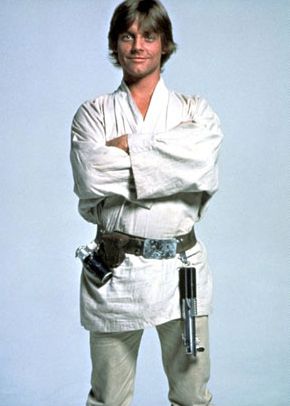
This goes beyond visuals; the same principle holds true of basic narrative, too. Consider this guy:


We’ve all heard more than we ever needed to about the “Hero’s Journey” and the “Monomyth” and all of Joseph Campbell’s theories in relation to Star Wars—which has, of course, become the template for much of pop culture. Well, what is “The Hero With A Thousand Faces” but a narrative application of the masking effect? Luke Skywalker’s a bland character—that’s not a bug, that’s a feature. He’s supposed to be a stand-in for the viewer, an empty vessel you can pour yourself into for a purer experience in narrative immersion.

Han Solo? There’s a character. He’s a specific person. Because of that, he works on a different level of narrative immersion—the kind that was more common before Star Wars came along. Because of course we want to be Han Solo. Why wouldn’t you? He’s awesome! He’s a badass smuggler who quips and flies a cool spaceship and gets the girl. Luke may have the awesome laser sword, but I’m guessing more little boys pretended to be Han.

So that blows my “masking” theory to shreds, right?

Not really. It’s just that Han represents a different philosophy of storytelling than Luke does. And here’s where we start getting to the root of an issue I have with modern pop culture wizards (because you knew I was going there eventually, right?)

Movies, in the olden days, strove more for Han-style characters. It’s not that there weren’t bland leads—Lord, were there ever!—but for the most part I don’t think they were trying for that. The idea was generally to produce textured characters who felt like real, which is to say, specific people. I do think there was some understanding of the masking effect, though it may have been rooted more in cultural concerns—of course the hero is going to be a square-jawed white guy—or marketing ones (as with the sudden shift to teenage heroes in the postwar years as they became a lucrative market). The idea of appealing to as broad a part of the population as possible isn’t some revelation, and “viewer insert” characters.

But there was something else at work: movies knew they set the trends for culture, and that people would look up to them to a certain extent. The people who made movies knew that if they could make X look cool, people would flock to X. Humphrey Bogart wasn’t an everyman. Marilyn Monroe wasn’t an everywoman. They were who they were, and people tried to be like them. Not vice versa. The movies, and thus pop culture, were dominated by the Han Solos.

This is one of many things Star Wars changed when everyone decided it was going to be the new bedrock for genre storytelling. The use of the masking effect was one of George Lucas’s triumphs, and it’s probably the single greatest reason that Star Wars was glommed onto as a formula—it (supposedly) provides a quick, easy way to make sure your audience of desirably young and cash-flush nerds can instantly relate to and love your story. Make your lead a bland everyman, and the viewer will fill in the blank themselves—with themselves. This is why, for instance, Harry Potter is such a blank slate, while his friends and teachers and enemies are so much more vivid characters. It’s why so many movies about other cultures are seen through the eyes of a white American, a la “Dances With Wolves”. And it’s why Hollywood is stocked full of blandly pretty leading men and women.

Perhaps you’ve noticed that I’ve gone from implicitly praising the masking effect to condemning it. In truth, the masking effect can be employed in far more sophisticated and complex ways. It’s shorthand, a nifty technique that can be laudable in the right hands. There’s nothing wrong with using a viewer insertion character to ease us into a strange world, for instance. But like so many useful artistic techniques, Hollywood has tried to reduce it to a formula, a crutch, or just an excuse to deliver vapid, bland characters. Perhaps more destructively, it’s led to a pop culture where so many protagonists are white heterosexual males in their late teens-early 30s without a distinctive job or any particularly strong beliefs, cultural background, or engagement in the world.

Because the problem is that we still crave Han Solos. Sure, we like being fooled into projecting ourselves into the role of a hero. But we can only be met halfway on this. On some level, when we read or watch stories, we’re looking for role models and aspirational figures. We need someone to admire. The masking effect essentially turns protagonists into mirrors—and thus, we’re constantly being told that we’re the heroes, if just for one day. (Not a coincidence that there are quote marks around that title!) As flattering as that may be, at the end of the day it becomes hollow, a deification of emptiness. If you keep portraying heroes who aren’t fully realized, who stumble through the world without viewpoints or ideas, who are only there to have things happen to them—then that’s the kind of figure people will start emulating.

But then, maybe that’s for the best. Those are exactly the kind of people who are easiest to sell movie tickets to. And everything else.

(I’ll have more to say on this subject after the holidays. Can you stand the suspense?!?)

Friday, December 21, 2012

Fourth World Fridays: The Forever People #6--"The Omega Effect!"


The Forever People is becoming quite the saga at this point—it’s the closest of the Fourth World books to the formula Marvel had evolved at that point, of endless, ongoing plot threads that weave in and out of an interconnected narrative. We’re now on our fourth issue that comes in sequence, and this is only made more explicit by the return of Glorious Godfrey and his Justifiers, who as you may recall were instrumental in the capture of the Forever People at the end of issue #3. The FP’s had left their vehicle, the Super-Cycle, on the cliff’s above Godfrey’s revival tent, and now a swarm of Justifiers in goofy flying shoes come across it and attempt to destroy it .

However, as the captions tell us…“On New Genesis, the creed is “life!” Programmed to ward off “death”, the “Super-cycle” defends itself!!!” Kirby, it seems, enjoyed using “quotation marks” for “no reason”.

The Super-cycle does an Optimus Prime bit and morphs into a high-tech self-defending fortress with, as far as I can make out, a radar dish made out of one of the wheels, and a laser gun formed from the chrome headers:


It incapacitates the patrol and earns the ire of Godfrey, who then sends an entire legion of new recruits to take the thing on (I couldn’t help chuckling—and thinking of Anakin Skywalker—as the recruits scream “YAHOOO!!!” with childlike glee on being sent out as cannon fodder.) “What’s the secret, Godfrey?” Asks his bespectacled sidekick. “The helmet? The uniform? The creed??” “Earthmen are given all those things at birth!!” beams Godfrey. “I merely justify their readiness to use them!!” Hey! I wasn’t issued a helmet and uniform at birth! Ripoff!!

Anyway, back to the FPs themselves. As you may recall, in the last few issues the Forever People were captured by Darkseid and held captive in Desaad’s torture palace/amusement park, Happyland, until their Mother Box escaped and found a warrior named Sonny Sumo who came and rescued them. Sonny also turned out to possess the power of the Anti-Life Equation which, when used in conjunction with the Mother Box, could be used to destroy free will, and Sonny is currently using it over the park’s loudspeaker to get the guards to surrender and release the prisoners.

Last time I mentioned that it was a little creepy to see the good guys wielding such a nasty power, and in this issue there’s at least some brief discussion of the morality of this. Obviously I can’t really blame them for making use of this ability when thrust into such a tight spot, but Beautiful Dreamer still comments on how “horrible” it is. Mark Moonrider says that, “as wielder of the power, Sonny Sumo is even greater than Darkseid himself!!” which seems like something you might not want to advertise. I mean, what if Sonny decides he likes using this power so much that he’s not going to give it up? It’s a lucky thing he’s shown himself to be such a noble warrior with a great moral code and all that. Also, what would happen if Sonny was to encounter Darkseid himself and start ordering *him* around?

It’s hard not to be a little frustrated here, since Kirby was trying to make a profound comic in some ways, that he pretty much ditched all these questions as soon as they come up. I guess that, for Kirby, when the urge to make a comic that “said something” conflicted with the urge to make a crazy explosive punch-up, the latter won out. It pretty much gets to the root of what I was saying earlier, about superhero comics being somewhat limited in their addressing of more subtle or complex topics due to their insistence on good guys and bad guys. Oh well.

Moonrider blasts a few bits of machinery, starting a chain reaction that causes Happyland to destroy itself. The prisoners crawl to safety, and the police arrive to arrest the meekly compliant guards (though, somehow, the Justifiers get away in their boxy shuttlecraft). Or, at least, most of them do—Big Bear manages to grab hold of one of them as he’s leaving and starts clowning around with it, thus providing this issue’s requisite Big Bear is Awesome moment:

JUSTIFIER: Mad-dog hippie!! You’re holding back this tonnage with your bare hands!!...
BIG BEAR: My stars, sir!! Can it be that high density atoms flow through, and reinforce my own atomic structure?
JUSTIFIER: You moving mattress!! You’re from New Genesis!!
(He shoots at Big Bear, grazing his skull. Big Bear makes a goofy face.)
BIG BEAR: Oops!! Well, Big Bear is my name, sir! – and power is my game!! That’s my bag, sir!! I store an excess of free atoms and send them where they’re needed!! Here, perhaps!!!

Then he hits the bottom of the shuttle and sends the Justifier flying, cartoon-like, out of frame.

(If they ever make a movie of the Fourth World, Big Bear will have to be played by a young version of Brian Blessed. Or possibly Jonathan Rhys-Davies.)

More Justifiers streak in and start firing before being put to sleep by Sonny’s voice power. “I’m glad you stopped this, Sonny!” proclaims Beautiful Dreamer. “Big Bear could have hurt these men!!” Sonny expresses confusion: “But I thought I was saving him!!” Like Big Bear ever needs saving, Sonny. He’s mostly just ticked off about “getting involved in all kinds of violence!!”

Off in the corner, Darkseid and Desaad are having a petty and slightly pathetic blame-fest of a conversation, in which Desaad whinges and Darkseid verbally lambastes him. “Don’t think I shall overlook your cowardice!! Then, all tormentors are notorious for this trait!!” As Desaad points out that there’s not much he can do against the Anti-Life Equation, Darkseid responds with, “Boldness, Desaad! Risk!! The raw meat of existence!!! I shall strike with these!!...And the Omega Effect!!!” Yeah, that’s right, Darkseid, castigate him for not taking risks, then whip out this heretofore-unseen superpower of yours that will let you destroy them all by remote control, without even leaving the room. That’s risk for you. Douchebag.

Darkseid proceeds to generate “finder beams” that shoot out of his eyes and start swooping around in vast curlicues. They don’t have far to look at first: Vykin the Black, hotheaded as always, has decided to barge in and confront Darkseid alone. This is really, really stupid, as, in traditional horror-movie fashion, the black guy dies first. Or gets eradicated from existence first. Yes, the Omega Effect is “The end—the total wipe-out!”, and now it’s streaking around, seeking the FPs.

Mark yells at Sonny to use the Mother Box to protect them, but Sonny and Mother Box are the next ones to go. One by one the FPs are annhiliated by the beams—Moonrider tells the remaining FPs to split up, but oddly, Beautiful Dreamer declares that she won’t leave him, and they go “foom” together. (That’s a little strange—there’d been a vague assumption on my part that Mark and Dreamer are lovers, but this is the closest thing we get to confirmation. And even this is a little vague, to say the least.)

The only one left is Serifan, who immediately breaks down sobbing and attempts to move into the path of the beam to end it all. What a wuss. Unfortunately for him (?) Darkseid turns off the finder beams, having lost interest in killing them all now that “the threat to us—has passed!!” Desaaad screams at him “You would leave such a dramatic experience incomplete? No, sire, no!” But Darkseid slaps him away. The kicker is that I would have bought it much more easily if he’d simply said that he wanted to keep Serifan alive and tormented by the knowledge that he’d failed—I mean, I agree Serifan doesn’t seem like much of a threat—but Darkseid explicitly says that he “doesn’t have the stomach” for Desaad’s sadism. So he’s decided to act like an idiot instead?

It gets even worse: Darkseid suddenly confesses that he didn’t actually destroy the Forever People: he just removed them from existence…in the present. OK, this makes no sense. It’s the height of convenient “villain leaves the room” behaviour that assures these guys will always be defeated. And besides, he just teleported the guy with the Anti-Life Equation—you know, the thing he’s utterly fixated on finding?—completely beyond his own reach. Smooth, Darkseid!

Serifan pulls himself together for the nonce, piles into the Justifier’s shuttle which Big Bear captured and uses it to head back to the super-cycle. Unfortunately, he manages to arrive just as the Justifiers from before launch their attack on it. (Wait—it took them all day to climb the cliffs?) Anyway, we’re now To Be Continued once more…

But wait! There’s a double-dose of Big Bear awesomeness in this issue, with a short back-up feature about he and Serifan fighting off an Apokoliptish patrol back in the days before the two planets openly went to war. Well, actually, it’s about Big Bear fighting them off, and Serifan whining and almost getting killed. My favourite moment is when Serifan glimpses the gigantic cannon the intruders plan to use to bring down Supertown: “It’s a horribly ugly pollutant!” Um, and it’s also about to wreck your home, Serifan. I’m concerned about the environment too, but geez. Meanwhile, Big Bear shows up carrying a huge log, gets shot at, declares “You’ve destroyed my exercise!” and proceeds to trash the invaders. Both of these guys are delusional and self-absorbed, but only one of them is AWESOME. Guess which.

Wednesday, December 5, 2012

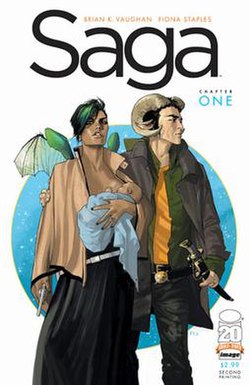
Comics Quickies: Saga


I'm strangely conflicted about Brian K. Vaughn as a writer. It's not that I don't like his comics; indeed, his work is usually a must-buy for me. But as much as I enjoy his stuff while I'm reading it, in the days afterwards there's always a cascade of "refrigerator moments" where the narrative logic starts to fray, or I start to find some of his narrative cutesiness and SHOCKING TWISTS annoying or cheap in retrospect. But the biggest criticism I have of him is that he's one of these guys who feels like he'd rather be writing for TV or movies--indeed, Vaughn wrote multiple episodes of LOST--and this sensibility mars his comics somewhat. As propulsive and page-turning as they are, the pacing and structure is pure TV, with little attempt to make use of the medium of comics. Even the visuals in his comics tend to be pretty low-key and mundane, relying heavily on naturalism, real-world reference, and the "acting" of his characters. To his credit, he almost always pulls this off, which is a testament to the quality of the artists he's worked with as much as his writing, but it's disappointing to see his focus lie so far from the kind of stuff comics can achieve.

Which is what's refreshing about Saga. This new epic SF/fantasy hybrid comic sees Vaughn stepping well outside his comfort zone, tackling more grandiose and comic-y subject matter, and even starting to take advantage of the visual possibilities of the medium in a way he generally doesn't. Some of the credit here must surely go to his artist, Fiona Staples, whose style is looser and more expressionistic than Y: The Last Man's Pia Guerra or Ex Machina's Tony Harris, but there's an overall feeling that Vaughn is stretching himself, too, creating narrative captions that are scrawled diagrammatically across the panels, robots who communicate their inner thoughts by flashing pictures on their TV-screen heads, and an unrelentingly fantastical universe full of weird imagery.

Though set against the backdrop of an intergalactic war and filled with pulp SF tropes like spaceships, robots, bounty hunters and pleasure planets, Saga is really a fantasy story in the sprawling, multi-book mode we're all familiar with. It opens with the narrator's birth, which makes it safe to assume that events will be playing out over an extensive period of time, and possibly spanning multiple generations, as the title would suggest. For now, the focus is on Marko, a horned magic-user, and Alana, a winged high-tech warrior, whose planets are at brutal, unending war. The two have defied their respective governments by falling in love, marrying, and producing a child, and now they're on the run across the planet, and eventually the galaxy, pursued by bounty hunters and a member of a strange, as-yet-unexplained robot royal family. The world Vaughn creates is rich and detailed and full of imagination, setting a grand stage for years of adventures to come, and his characterizations are more heartfelt than usual (though Alana can sometimes fall into the reflexive, hipper-than-thou posturing a lot of Vaughn's characters are guilty of). Vaughn has, ironically, stretched himself by embracing what could be considered a more traditional "comic book world", and the results are quite appealling. While the cynic in me is positive Saga will eventually fall prey to the slightly rushed and credibility-straining plotting that dogged Y and Ex Machina (though admittedly it never completely derailed either of those series), for now, Saga is another typically strong start for Vaughn, and an interesting promise of something different than what he usually offers.

Saturday, November 24, 2012

Treklife: This Is Not The Kirk I Was Promised


I only watched the classic Trek for the first time in its entirety a few years ago. As a TNG-loving teen I'd made a few attempts over the years, most notably dipping into a Trek marathon that aired on Canada's Space Station over...the holidays, I think? Or possibly while I was out of school, sick? I honestly don't remember, though being sick might explain my inability to engage with it. Or maybe that's just because I was, y'know, a teenager. Camp is the bane of teenagers, and TOS was campy even at the time it was made. I was outgrowing the kinds of clunky TV shows I'd uncritically consumed as a kid and embracing a whole new set of supposedly cooler shows, ones that offered more superficial appeal and engaged with my adolescent reptile thrill-seeking brain. You know the drill. You went through it yourself.

This dorky, extremely low-budget series with its hammy acting was too ripe for my newly minted sense of reflexive irony. I've actually always been a little more open towards older movies and TV shows than many, even as a kid, but Trek just didn't click. I think it might have been the fact that it was nominally connected to The Next Generation--instead of being free to be its own thing, I could only view it through the lens of the new show. I ended up sitting there and nitpicking how ridiculous the Klassic Klingons looked and trying to concoct reasons for why the Cardassians or the Ferengi weren't on anyone's radar back then.

As an older, "wiser" specimen, I've actually found my tastes becoming broader and my willingness to engage with art on its own terms expanding, and thus, with J. J. Abrams' reboot was threatening to hit the screens, I borrowed the box sets from a friend and delved in.

(My thoughts on Abrams' remake have cooled quite a bit, but I enjoyed it at the time, and in fact wrote this snotty review of Trek in general that ticked a lot of people off. I did mean it tongue-in-cheek, but yeah, that was kind of dickish of me. You should probably read that before continuing.)

I think one of the things that caused me to write that review--that caused me to fall away from Trek in the first place--was my reading about the backstage travails of how it came to the screen. You see, I really *believed* in the ideals of Trek. I still do. Exploration, rationality, communication and compromise, striving towards a better future. These have become a major part of my moral makeup, and Trek is a big part of why. And I was naive enough to believe that the show's creators shared these ideals.

But of course, it's just a fucking TV show.

It's not even some story of Hollywood backbiting that drove me off (though it became clear later that Rick Berman was quite a tool.) It was the underlying cynicism and laziness that was beginning to seep into the show, the way the writers didn't seem to care much about exploring the issues they raised anymore, the way continuity was shredded and characters treated callously. Basically, all the stuff I wrote about in my last post on the subject. But it was exacerbated by my growing awareness of the way TV shows were made.

Look, I'm aware that art isn't some perfect, pure process in which the muses flit down on wings of saffron and caress the artist's brow to provide inspiration, and even if it were the process of getting it to the screen would require change and compromise. I know that the ethereal, platonic magic that stirs your soul has to go through a mundane process of realization, which can be reduced to charts and graphs and scripts and outlines and formulas. All artists have a physical process. I know that now.

But at the time I felt deeply, deeply betrayed by uncovering Trek's relationship to showbiz, and combined with the way that, in the latter seasons of TNG, no one involved seemed to care all that much, it provoked a hostililty that lingered all the way to 2009, when I wrote that review.

So there's that.

Really, though, what I was still reeling from--and what I now find fascinating--is just to what degree classic Trek isn't the thing everyone seems to think it is.

We all know the litany: a post-scarcity future with prosperity and enlightenment for all. The Vulcan reverence for Logic. The Prime Directive. The emphasis on communication and co-operation. The glimpse of a better future for mankind. These are things that have a powerful appeal.

Which is why it's so astounding that the classic series was so conflicted about all this stuff.

Decades later, Roddenberry and the fans codified the above ideas as the core of Trek, and it's been that way since the movies. But the thing is, Roddenberry wasn't that great a writer, and he left a lot of the work to a talented team that seemed to have different ideas about what Trek would be. This clash of ideologies made it into everyone's Platonic ideal of the show to a degree, but Roddenberry's vision has been the one that prevailed.

Roddenberry clearly was a socialist democrat who believed in military adventurism (I’d argue he was more mainstream in the 60s, some of the more offbeat stuff that crept into his thinking–a slightly creepy collectivism, for instance–having come later) but the show had libertarian and counterculture writers as well. Likewise there are episodes like “The Way to Eden” which is pretty contemptuous of the youth culture of the time, yet a lot of other Trek stories seem to embrace it in more subtle ways, particularly the idea that there’s something ridiculous about authority and that love, peace and harmony can triumph over evil (and “Way of the Gun” sees the crew using passive resistance and an oddly Buddhist mindset to overcome violence.) There are episodes that can be read as both for and against the Vietnam war (which is really what the Prime Directive was about in the first place) and episodes that are both for and against organized religion.

As for Spock, he definitely seems to have been created as a straw man--someone to show the value of humanity and the perils of relying on logic entirely. And yet it doesn’t take too long before the writers seem to start siding with Spock on a lot of things–in fact, he almost seems to be the representative for the counterculture at times, his spirituality being almost as big a point as his logic. In “Space Seed” Spock is appalled to hear everyone else speaking well of Khan, and I can’t imagine we aren’t supposed to, at the very least, sympathize, if not completely agree. (And it’s interesting to me that the supposedly detached, logical character is the one taking the firm moral stance while the more emotional humans can admire the historical monster, if somewhat back-handedly; conventional storytelling would have flipped that to criticize Spock's logic, but here it seems like humanity is the one that’s in danger of falling under the sway of a charismatic figure.) Of course there are plenty of “silly Spock, there’s more to life than logic” episodes as well, but the character was no Agent Scully, there just to voice the “wrong” opinions. (Actually I’d argue even Agent Scully wasn’t an Agent Scully, but I’m drifting from the point here.)

Likewise, there's the idea of a post-scarcity society without money, which looms so large over discussions of Trek, but which barely seems present on the original series. It’s implied by the replicators and so on, but the way everyone’s needs seem to be taken care of could be chalked up just as much to the fact that this is a pseudo-military organization as to anything else. Isn’t there discussion of mercantile arrangements in the early episodes? Isn’t Harry Mudd basically a con artist? What’s he swindling people out of if not their money? And I could have sworn Scotty or someone mentioned getting paid, though of course he could have been speaking figuratively.

Finally, there's the Prime Directive. The fact that Kirk violated the Directive practically every week is, by now, a cliche, but what's even more interesting is that, looking at the original series in isolation I honestly couldn’t tell you if the writers meant for it to be seen as a good thing or a bad thing. It often seems more like a dramatic obstacle than a philosophy, something that was just there so that Kirk could show off what a badass renegade he was--the Cop Who Plays By His Own Rules transposed into the 23rd century. And indeed, Starfleet in general seems to be heavily populated with stiff bureaucrats who exist only to make Kirk's life miserable.

Utopian future? I don't think so.

It's a fascinating series precisely because of these contradictions, and it's ironic that the show's own creator asserting his creative vision arguably produced something less interesting. It's certainly a handy riposte to people who think Trek's vision of a relentlessly positive future is naive or unworkable: that vision never really existed...


Friday, November 23, 2012

Fourth World Fridays: Mister Miracle #5--"Murder Machine!"


I love that cover. I love that Vundabar wasn’t quite certain enough of the flamethrower and the gun and the A-bomb, so he added a dagger. To kill a guy fully encased in a metal casket.

Proving that shamelessly gratuitous cheesecake pinups are just as much a part of Kirby’s ouevre as any other adventure artist’s, this issue opens with a full-page splash of Barda in her red bikini mode, doing calisthenics. He even provides audience surrogates, in the form of a bunch of deliverymen who have come to deliver a civil war cannon Scott’s ordered, but get an eyeful of Barda and make construction-worker noises at her. She of course puts them in their place by picking up the 20-ton cannon (with one hand!) and carting it off, leading to the traditional “This ‘women’s lib’ thing is getting more serious than I thought!” reaction.

A word, please? If you don’t mind? Thank you. I’m 100% on the side of feminist superhero fans who find the subculture creepy and weird and misogynist at times, but I don’t think stuff like gratuitous shots of a muscular, bikini-clad woman exercising is what bothers them. I think the real sticking point is when female characters are badly or thinly written AND they’re constantly being offered up for oglement by the artist. The female character serves no point and is in no way memorable or interesting except as a sex object—hence “objectification”.

There’s a certain trope comics frequently use to try and spackle over this kind of exploitation, namely, the “Generic Kickass Female” argument. The character is superficially heroic, strong, can fight off an army of ninjas with one hand behind her back, etc. So, argue the writers and artists, she’s a positive female role model! That’s all well and good, but just making her “kickass” doesn’t totally mitigate the sexism. Turning a vapid, scantily-clad sexpot into a vapid, scantily-clad sexpot who punches people a lot is not exactly a great blow for women’s rights; it’s just a knee-jerk bit of ass-covering. And honestly, it’s become such a cliché that it always bothers me when it shows up.

So why don’t I think the brazenly cheescakey Barda sequences in Mister Miracle count against this? Well, the answer is more or less implied by the above. Barda is not only a memorable character, she often comes close to overshadowing the hero of the book by force of her personality alone. Furthermore, she’s not really a traditional image of beauty (maybe less so now than in 1971, but still). If anything, this whole sequence is a pretty solid example of being sexy without being exploitative. Still, I had to admit I was rolling my eyes a bit at the deliverymen’s “Bu-WHA?!?” reaction.

But on to the actual story, which, fortuitously for my purposes, involves one of those villains that only Kirby could have thought up. Okay, maybe he’s not the only one who could have thought him up, but he’s the only one who would have done so and then actually had the guts to build a comic book around him.

His name is Doctor Virman Vundabar.


And yes, he’s basically a cartoonish, 19th century Prussian dictator.

For the record, I’m pretty sure that Kirby was somewhat aware of the camp value of this comic and even saw it as a selling point; witness Big Bear’s comments about their décor in The Forever People #2. And this is a comic book, which at that time still benefited from being cheap, disposable entertainment for kids, and could thus get away with stuff most other media couldn’t.

Still, Vundabar is pushing it. And yet, Kirby manages to add another, interesting level to all this later on, as we’ll see.

At the moment, one of Vundabar’s lackeys, name of Hydrik, is displaying his prototype deathtrap which Vundabar, natch, intends to use on Mr. Miracle. The trap—in which a dummy is shackled to a hydraulic spinner—is a pretty spectacular failure; not only does it self-destruct, but the Mister Miracle dummy is thrown clear! The point being to demonstrate that Miracle would have escaped, but honestly, the fact that a lifeless mannekin was able to escape shows that Hydrik’s competence at building deathtraps is roughly akin to that of a Narwhal’s. To top it all off, Hydrik’s machine “severely impairs” him when it explodes, and a sneering Vundabar puts a bullet in his head as he lies there helplessly. You know, I know it’s standard M.O. for supervillains to cack a henchman or two to prove their evilness, but this one bordered on a mercy killing.

Meanwhile, Scott is setting up his new civil war cannon (where’d he get the money to afford that, again?) while Oberon complains that Scott’s got him dressed up in a Confederate outfit. Or maybe it’s a Union. Whichever one is blue. (Hey, I’m a Canadian. We didn’t learn this stuff in school.) Of course, Oberon’s complaints that Scott is robbing him of his dignity are entirely justified, but he continues to go along with it after Scott gives him an extremely perfunctory “Hey, you’re as important to the act as I am!” speech.

At least Oberon manages to wheedle some more information out of Scott and his backstory while he’s about it. Scott explains about Granny’s Orphanage between his escape from being strapped to the cannon while it’s lit (a pretty perfunctory escape, actually, though Oberon naturally does a lot of squealing about it). We get the basic idea that we’ve pretty much already figured out: that there’s a weird, never-fully-explained code of honour restricting the Apokoliptians from just tromping over and killing Scott…despite the fact that they fight dirty on several occasions.

Perhaps more interesting is that extra layer to the inherent campiness of the comic that I was talking about earlier. Vundabar, like Scott himself, is an alumnus of the orphanage, where, it’s now made clear, the orphans were given silly names in Kirby’s homage to Oliver Twist. But more than that, they were given ridiculous identities, themes, and traits by Granny, and by extension, Darkseid. Vundabar took his to extremes, but all the orphans of Apokalips have had their personalities, basically, assigned to them—which makes their goofiness kind of tragic, when you think about it. It’s a very nice fit with the themes of the comic, and the Fourth World as a whole: the various ridiculous personalities of the Apokaliptians are a cruel joke on the part of Darkseid, and a measure of just how determined he is to control everyone and everything. He’s essentially condemning his soldiers to lifelong humiliation, and getting them to play along with the joke. Scott’s escaped from this humiliation just as he’s escaped from his homeworld, by building his own personality.

(Though there’s a bit of an irony here, in that Granny named him “Scott Free”….so by rebelling and escaping, he’s still fulfilling the destiny Darkseid handed down to him. Which adds yet another level of complexity to Darkseid’s motivations, which I’ll discuss in a later entry.)

Anyway, while Scott and Oberon are rehearsing, Barda’s completing her cheesecake quota for the issue by splashing around in a nearby pond. She reflects on how much pleasant it is here than on Apokalips, though interestingly when she name-drops Darkseid, even negatively, she can’t help but add “great” to the beginning of his name, a nice, subtle way of reinforcing just how much brainwashing she’s undergone. Meanwhile, a bunch of Granny’s pointy-headed troops have snuck up behind her, but of course Barda’s too good to be taken by surprise like that; she activates her armour, which materializes around her, and begins laying waste. So naturally the pointy-heads have a secret weapon up their sleeve to conveniently neutralize her so they can carry her off. Even though she put in a good showing, I still say she went down a little too easily for the kick-assiest warrior babe of the Fourth World, but never mind.

Scott catches sight of the “Magna-lift” as it departs over the treetops, and somehow intuits that Barda’s been kidnapped, which means of course that it’s time to summon his aero-discs and follow after. Scott somehow further intuits that Barda’s been taken to the remote Barclay Canyon, and even more astonishingly, figures out that it’s Virman Vundabar who took her. Man, Scott’s become a psychic. Sure enough, he finds a bright orange complex waiting for him with Vundabar’s image greeting him on an image=screen at one end. “It probably also serves as a door to your trap! Very efficient, Virman!!!” Um, that’s how you prove Virman’s love of efficiency? What about the fact that he went to all the trouble of kidnapping Barda, even though Bedlam was able to sucker him in just by offering a challenge?

Vundabar starts ordering Scott to enter the compound. “What if I tell you to go blow your nose!?!” spits Scott, master of the snappy comeback. (As you’ll recall from the end of issue #2.) But of course, Vundabar’s offering Barda’s life in exchange for Scott’s compliance, so he steps onto the track and is immediately encased in the conveyor belt o’ doom pictured on the cover. On the next page, he’s battered by giant metal hammers and electrocuted by what Vundabar’s new henchman Klepp calls "a controlled atom blast”. Vundabar refuses to gloat until he knows for certain Scott is dead, but lest you gain any respect for him at this point, he then turns his attention away to provoke Barda. There’s an interesting exchange here:

BARDA: That’s why I deserted Apokolips! I can no longer soldier in the company of twisted fiends like yourself-who worship their power--more than Darkseid!
VUNDABAR: Silence! I want no further blasphemy! Great Darkseid rules Apokolips like a colossus!! His is the creed of destruction! --Not fair play! I accommodate my whims--but I also know that my opponent must be destroyed!

OK, that’s pretty confusing. Shouldn’t Vundabar be saying, “Darkseid accommodates my whims”? How do you accommodate your own whims? But the general idea here seems to be that Barda is accusing Vundabar of being disloyal to Darkseid, in a purely intellectual sense at least. What’s more, she seems to be admitting that she still feels loyalty to Darkseid! Or rather, that she’s still committed to the idea of Darkseid. This seems to be a case of being so faithful to the image of someone that you have to rebel against them when they fail to live up to their own standards. Anyway, it’ll be interesting to see what happens when the two of them meet…

Anyway, the Murder Machine passes through flamethrowers and then an acid pit at the end that melts it into nothingness. The toadying Klepp proceeds to ask “If I cannot laugh now, please allow me to applaud!!” To which Vundabar replies, “Laugh away, Klepp! Here -! I’ll join you! AHAHAHAHAHA!!” That’s pretty funny—Vundabar apparently doesn’t allow himself to laugh very often.

And need I point out that Mr. Miracle is standing right behind him in this panel, looking smug?

Yet again, the villains are horrified to find that Scott escaped from a locked cabinet which they couldn’t see inside of. “A mother-box!” Screams Vundabar. “With the aid of a Mother-box, you thinned your atomic structure and transferred yourself out of that coffer!” “Not so!” replies Scott. “Even in the ‘crunch’ I play it fair—and you know it!!! You thought of everything, Vundabar--except the soles of my shoes!! You couldn’t see the laser-jets activate!! The jets burned through my foot clamps but not those that held the coffer fast to the moving track! Then, with a short by powerful laser beam, I blasted downward!!” And crawled out through the hole, digging downwards and coming up behind Vundabar.

So, um. Using the Mother Box is cheating…but using foot-rockets isn’t? This is what keeps bothering me about this comic. Most of the time, Scott escapes simply by using whatever gadgets he happens to have brought with him, even if we’ve never heard of them up ‘til now. Scott rarely uses actual escape skill or even his wits to get away. Sometimes it’s worse than others—the “Paranoid Pill” business was actually pretty clever—but this falls under the discussion of whether Superman is a lousy hero because he can save lives and do what’s right without much exertion on his part.

Anyway, Vundabar immediately proceeds to try and cheat by blasting Scott at point-blank range, whereupon the floor collapses underneath them—Scott had dug it away, after all. He then lifts Barda in the classic “Creature From the Black Lagoon” pose and carries her off.


Wow, condescending much, Scott? So much for powerful female role models…