Showing posts with label Pop Culture Will Eat Itself. Show all posts

Wednesday, February 13, 2013

Here's One For TV Tropes

Charlize Theron, Snow White and the Huntsman

So here's an annoying pop culture cliche I've recently become aware of: the Older Woman as Vampire.

Obviously this is something that goes back to Snow White and similar myths, but it's something which I notice modern Hollywood has had no problem embracing recently. Including in the two recent Snow White adaptations. The place where I first noticed it, though, was (God help me) the Halle Berry Catwoman movie. In my defense, I haven't watched this all the way through, because it was pretty much unwatchable. But I saw enough to register that Sharon Stone's villain was apparently drawing some kind of superpower (stone skin? WTF?) from the cosmetic products she was trying to sell, which were also apparently going to mutate everyone who used them, or some such nonsense. It was clearly meant as an oh-so-satirical takedown of the beauty industry and how desperate some women are to hold onto their looks and blah blah blah.

It popped up again in Stardust, with Michelle Pfeiffer as the evil aged witch who wanted to cut out Claire Danes' heart to restore her youth (and her sisters'), and then, of course, in Mirror Mirror and Snow White and the Huntsman. There are other, similar examples, and echoes of it that don't follow the trope exactly, but the gist of it is: older woman who resorts to horrific, unnatural means to keep her looks, which puts her at odds with a younger, naturally pretty girl. The former is the villain, the latter is the hero.

Like, for instance, the "Magical Negro", this is a trope that might not actually be so bad if it didn't keep popping up over and over again, to the point of cliche. I mean, vanity is a bad thing, and people have indeed resorted to unpleasant means throughout history to stave off their own mortality. Obviously heart-eating is to be frowned on. But the problem here is where the dart of empathy is aimed: always at the young. The cumulative effect is to value young and "naturally" pretty girls over older women, whose looks are fading and who, thus, have less value in their own eyes...and the people telling the stories don't do much to suggest that they disagree, frankly.

I don't think I'm breaking any radical new ground here; I'm sure any feminists reading this are thinking "Wow, such dazzling insight, Adam! Now do you have any thoughts in re: the wetness of water?" But I do think it's worth commenting on how much Hollywood seems to exaggerate this effect. There's a pretty clear hierarchy at work here: if you're a young, hot starlet, you get to play the heroine; if you've been able to drink for a decade, it's time to start relegating yourself to villainous roles. Yes, yes, I know, twas ever thus, but it seems like there's a renewed meanness to it of late, particularly the Sharon Stone bit. All of these women are still gorgeous, particularly Theron, who isn't even fucking 40 yet, but here they are playing decaying hags, and worse, evil decaying hags who only exist to make life hard for some vapid pretty girl.

"Yes, Adam, and FIRE HOT," chant the feminists.

I know, I know. And I am used to women being valued only for their looks in the movies. But even in this superficial context, can't we at least get some movie producers capable of recognizing female beauty in someone over 30? I mean, it's not rocket science. You don't have to use some kind of formula. Yet it kind of seems like that's what's being used to determine what makes a woman "hot", as opposed to, y'know, looking.

And the end result is that not only are women being treated as if only the young ones matter, but women are written as if they themselves believe it. At the end of the day, I think this is one of the more inherently pernicious concepts in storytelling, far more than simple sexualization. There's no inherent reason a sexualized woman in a movie can't be an interesting, well-fleshed out character (I mean, they usually aren't, but there's no reason they can't be). But relying on the "evil queen" who's jealous of a younger woman--no matter how subtly it's played--automatically reduces women to the status of objects. It'd be nice if more people in the media paid attention to what they're saying with their stories.

Tuesday, January 29, 2013

Justified

Dredd (2012) Poster
2012 was a somewhat odd year for movies for a number of reasons, but one of the oddest was the fact that it featured a great number of enjoyable summer blockbusters...almost none of which actually opened in the summer.

I'm not so jaded that I can't enjoy a big fireworks display of a movie, as long as it's done with a certain level of inventiveness and panache, and Chronicle, The Hunger Games, The Cabin In the Woods, Looper, 21 Jump Street, Rise of the Guardians, John Carter, and The Pirates! all scratched that itch rather better than a lot of Hollywood's recent offerings in this arena. A couple of them are downright great, and even the ones that were merely passable diversions were loads more fun than the movies that opened during the actual summer season*, the soggy likes of Battleship and Prometheus and that Snow White movie (no, not that one, the other one). Even Pixar and Christopher Nolan let me down this year. Oh yeah, there was The Avengers, which was almost the platonic ideal of a popcorn movie, but that opened on May 1st, which, sorry, ain't summer where I come from. (I come from Canada.)

And then there was Dredd. (Spoilers follow.)


Dredd didn't do very well in theatres, though I'm told that it's the best-selling DVD of the admittedly young year. This fact has awakened some hope of a sequel amongst the film's nascent cult, and it's this fact that made me consider some issues about this film...which I'm not entirely comfortable with.

To get the obvious out of the way, Judge Dredd was created in 1977 by John Wagner (writer) and Carlos Esquerra (artist), first appearing in only the second-ever issue of the evergreen British comics anthology 2000 AD. The character is part of the wave of punk-rock comics of the time, created as a satire of the American fetish for rogue law enforcement officers who act as "judge, jury and executioner", and inhabiting a berzerk cyberpunk world that played a major role in defining "cyberpunk" in the first place. As with rock 'n' roll, Americans may have invented comics, but the British were the ones who really saw the art forms' potential, and a level of tongue-in-cheek irony of a kind foreign to contemporary American superhero stories pervaded the strip. Dredd became, and remains, a wildly popular character in the UK, but Americans mostly know him from the awful 1996 Sylvester Stallone movie. The fact that Dredd removed his helmet was the least of the movie's problems; more than anything else, it seemed like adapting Dredd into an actual big-budget American action movie had robbed the movie of its ironic, subversive charge. (Robocop was heavily inspired by Judge Dredd, and I'd argue it captures the strip better than ether of the nominal adaptations. Perhaps not coincidentally, director Paul Verhoeven is European.)

Dredd is a fun, quite well-made movie, and I enjoyed it tremendously. But it falls prey to a tendency that's become overwhelming in geeky adaptations: they labour under a weird, creeping sense of obligation that sometimes overwhelms the need to make the best movie possible, or even the best adaptation possible.

With this movie, director Pete Travis set out to make a movie that would be much truer to the character--which actually seems to boil down to the fact that they wanted a Dredd movie where he never took his helmet off.

Look, I get that this is a big deal in the comic, but this is a movie, people. In much the same way that geeks moan endlessly when an actress of the wrong hair colour is cast for a comic-book role, this seems like a weird fixation on a superficial detail. I'm not saying that it's not nice that Karl Urban's Dredd keeps his helmet on; I'm just saying that making that the lynchpin of the movie resulted in a rather underwhelming story.


Because if you switch out the character of Dredd, you'd be left with a relatively generic, though well-made, action story (as everyone keeps saying, the similarities to The Raid: Redemption are inescapable), and that seems like a missed opportunity. Travis and company were quite open about the fact that they were going to make a small-scale story due to budget issues, and while that's fine as far as it goes, the problem is that the script thinks too small. The vast, sprawling, nightmare world of Mega-City One is basically ignored (and what little we see of it just looks like a generic, modern metropolis) and the bulk of the action reduced to a single, admittedly huge, apartment building. Fair enough, but there's no sense of the personality of the city surrounding it either. Indeed, there's little trace of the tonal subversiveness or snotty nose-thumbing that makes the comic so memorable either. Even Dredd himself is given very little to play off of; sure, he's the authoritarian hard-ass we expect, but this isn't really explored by the story in any serious way. Dredd never, for instance, has to make a choice between following the rules and basic humanity, and the ramifications of this borderline-fascist legal system don't play a role in the plot at all, other than the shock of a cadre of corrupt Judges who pop up at the halfway point.

And therein lies the rub: this movie seems to have been made solely to validate the character after the Stallone debacle, to give fans of the character something to point to to show that he's actually good. In that way, it plays directly into the modern idea that movies are somehow "better" than other media, and that no matter how much you love that comic or novel or TV show, it hasn't arrived until it's been turned into a big-budget CGI-fest. Even this wouldn't be so bad if the resulting movies didn't end up feeling like they were made using a checklist, afraid to take too many chances, providing as direct a transcription as possible for the sake of the fans. We're a long way from the era when Jaws and the Godfather ended up being a vast improvement on the original pulp novels.

Which brings us to the possibility of a sequel. Again, the filmmakers are on record as saying that, should the first film do well, we'd be getting a sequel featuring some of the more unique elements of the comic. Again, I get the necessity inherent here, but this seems to be the standard approach for far too many comic-book and other "geek" properties--a small-scale, unambitious movie that sets up a potentially better sequel. This doesn't have to be bad, of course, but too often it seems like the filmmakers are shirking their responsibility by doling out the property in bite-sized chunks rather than straining themselves to deliver the best movie they possibly can. It's like if the first Star Wars movie had only hinted at the big Death Star battle, with Lucas promising we'd get to see it if the first movie made enough money.

What I really object to about this is that it puts a burden on the movie-consuming public--give lots of money to the corporation, and maybe you'll get a treat! Obviously this attitude popped up organically among film nerds over the years, but Hollywood has been quick to exploit it. Essentially they're trying to be rewarded for stretching the property as thin as they possibly can, and it smacks of a con job.

Don't get me wrong: if a Dredd sequel gets made, I'll be first in line. But it would be nice to get the sense that the filmmakers had given it their all the first time, that they weren't selling a promise as much as a movie.


*And then, just to compound the weirdness, the two best movies of the summer were Moonrise Kingdom and Beasts of the Southern Wild, both ultra-precious indie movies of the kind that usually haunts arthouses in the early fall. And they did well!

Monday, January 21, 2013

Muckraking


The last two reviews I’ve done for Thor’s Comics Column (The End Times of Bram and Ben and Todd, the Ugliest Kid in the World ) have inadvertently been thematically linked. Both of these books are deliberately, gleefully offensive, something that’s become a time-honoured tradition in the medium of comics since at least the era of “Tales From the Crypt”…and really, it goes back to at least the days of 18th-century political cartoons. Or hell, dirty paintings on cave walls. Comics seem more inclined to this kind of assault on good taste than most other media, something I accredit partly to how few overseers the standard comic has in the production phase, and partly to how far beneath the radar the average indie comic is able to fly. But even without those aspects I feel like there’s something in the medium itself that lends itself to assaulting people’s delicate social mores—a certain underlying anarchy implicit in portraying reality in stylized form. (Animation has something similar going on, from the classic Loony Tunes to the modern slew of R-rated cartoon shows.)

As you might be able to tell, I’m generally in favour of pushing boundaries, but that doesn’t mean I automatically salute comics creators who publish whatever juvenile, offensive nonsense they can get away with. As I said in the reviews linked above, I think taking a scattergun to good taste can be a positive thing…if done in an intelligent context. The more over-the-top your shock value, the more carefully it has to be deployed, and there’s no quicker way to get on my bad side than being shocking for the sake of being shocking. Perhaps more importantly, if you’re going to talk the talk, I expect you to walk the walk.

I’ve been to the San Diego Comic-Con a few times, thanks largely to friend and collaborator Chuck Whelon. My first time there, in 2004, was juuuuust before the huge crowds of non-nerds caught on that this was a chance to catch a glimpse of big movies and their stars and directors before they were released, and it was still possible to get in to see them without spending most of the convention waiting in line. In later visits I tended to skip the madness of Hall H and focus on the actual comics, but that first trip was spent planted in the big lecture halls watching advance clips of The Incredibles and listening to the creators of Sky Captain and the World of Tomorrow (it was a pretty good year for neat geek projects, in retrospect).

One of the presentations I saw that year was for Team America: World Police. I knew Trey Parker and Matt Stone were working on an all-puppet action movie that would lampoon the war on terror in the style of the Thunderbirds, and while I wasn’t the world’s biggest fan of the duo, I thought the combination of the uniqueness of the medium and the subject matter made it sound like an exciting flick. What I saw on the stage, though, turned me against Parker and Stone for life. I understand that they were in the late stages of finishing the movie and were rather exhausted, but the hour-long presentation consisted of nothing but whining from the duo—whining about how much they hated actors, whining about how much harder it was to work with puppets, whining about how much hard work this all had been. When you factor in the incredibly simplistic, half-assed animation of South Park, it became clear to me that these were a pair of over-privileged jerks who thought it was the height of hilarity to mock everyone else but whose own inconvenience warranted a jeremiad. This was emphasized when the movie came out and large chunks of it were devoted to repetitive, tiresome “takedowns” of everyone in Hollywood Parker and Stone personally disliked, including a nonsensical plotline springing from their personal vendetta against Michael Moore.

Now, I know what you’re thinking: “He’s only saying that because his political beliefs are being tweaked.” But actually it’s just the opposite. I’m a hardcore leftie, but I’d LOVE it if someone delivered a smart, incisive takedown of Michael Moore. That’s not what Parker and Stone did, though. The Michael Moore segments of the movie are simply Parker and Stone taking revenge on a guy who done them wrong (Parker and Stone were featured in Bowling for Columbine but refused to make an animated segment for the movie; Moore proceeded to make one in the style of South Park and place it right after the Parker and Stone segment, which the duo felt mislead people into thinking they’d been active participants in the movie rather than interview subjects). There’s no real criticism of Moore’s beliefs other than linking him to the movie’s half-baked “liberals are terrorists” theme, which isn’t any more well-thought-out than the kinds of idiocies that right-wing talking heads were spewing during the Bush years. What’s almost worse is that Parker and Stone present this whole thing as surrounded by ironic quote marks, dramatizing right-wing talking points with a veneer of ridiculousness so that if called on it they can say they’re satirizing it. It’s the ultimate in having their cake and eating it too.

For the record, I have enjoyed South Park in the past, and I’m not trying to argue that Parker and Stone are are right-wing lunatics. Actually that’s almost the problem: I don’t think they actually believe in anything, and are simply taking an aggressively contrarian stand to get noticed. Which wouldn’t be so bad in and of itself, but combined with the aforementioned sense of privilege and whininess, it becomes excruciating. (A gay acquaintance of mine was extremely angry at the episode that called for people to ease off on criticism of “the f word”: “So, these privileged heterosexual Republican-voters are going to lecture me on being offended by a slur aimed specifically at people like me?” was the thrust of his complaint.) Apparently a recent South Park episode featured metacommentary on Parker and Stone’s growing displeasure at their need to be relentlessly cynical and negative towards everything, to which I can only quote Porky Pig: “You b-b-b-b-buttered your bread, now you can lie in it.”

Another guy about whom I have similarly mixed feelings is Garth Ennis. Unlike Parker and Stone, I don’t think Ennis is a nihilist, and in fact, I think he can be a really excellent writer. But as anyone who’s read a lot of his work knows, he can very definitely fall into the same adolescent contrarian stance. There’s his incredibly, often pointlessly graphic violence, his depiction of superheroes as out-of-control, amoral hedonists in The Boys, and his juvenile mockery of religion in Preacher. I’ve actually read Preacher multiple times and own the entire series; it’s unquestionably an engaging, entertaining story, but I’m consistently disappointed by how Ennis keeps trying to pretend he has something to say, about religion or America or anything else, when it’s pretty clear he doesn’t. Christianity only exists in Preacher as something he can bring up for a cheap, shocking gag once in a while; the only people who are going to be offended by it are the kind of fundamentalists who wouldn’t be reading the comic in the first place. It’s a nonstop parade of “Hey, you hold this stuff sacred? Well, fuck you, I’mma smear shit all over it! Ha ha!” Ennis never even really gets around to explaining WHY religion is bad; he just takes it as self-evident. He’s shooting fish in a barrel. (And no, I’m not religious. If I’m offended by any of this jive it’s not the subject matter but how much contempt Ennis has for his readers.) 


After all that, I probably come off as a hopeless prude, but I reiterate my original point: I’m a strong supporter of thinkers and storytellers who attempt to push boundaries. My issue is with people who take “causing offense” as a starting point. To stay on the religion thing, Charles Darwin didn’t sit down and attempt to destroy the bible by writing The Origin of Species (regardless of what certain fundamentalists seem to think); he simply followed his thoughts to their rational conclusion, and came back with a book that shocked half the world. The same is true of Alfred Kinsey or Friedrich Nietzsche. This may seem like a somewhat lopsided argument, that I’m holding up an impossible standard to pop culture storytellers, but you see my point—nothing is ever more shocking than ideas. An obvious provocation can garner attention in the short term, but all you’re doing is shoving something into the muck. Muck washes off. Exposing an existing rot within your chosen subject—that’s far more dangerous, and it’s what art should be doing.

Saturday, December 22, 2012

Mirror, Mask

There’s a phenomenon I’ve been fascinated with ever since I first had it elucidated for me in Scott McCloud’s “Understanding Comics”. McCloud calls it “the masking effect”.

Basically, cartoons can achieve a kind of universality that isn’t directly available to any other medium, through their sheer simplicity. We’re visual creatures, and to us the world outside is a rich, textured environment, and the people we deal with every day are distinguished via the details that we slowly become familiar with. Other people are something we observe, and take on an elaborate shape in our minds. But, McCloud says, most of us aren’t nearly as familiar with our own face, because we only see it comparatively rarely. To us, on the other side of the mask, our face exists more as a concept, or a series of non-visual sensations. We imagine the basic placement of eyes, mouth, nose, but we don’t connect it in a concrete way with how we look at any given moment. We don’t picture our freckles or pores or the spot we missed shaving, whereas to anyone encountering us these are prominent features. Everyone else is part of the physical architecture, but we exist to ourselves in an almost Platonic, semi-abstract state.

In other words, a simple, undetailed cartoon rendering of a face is a reasonably close approximation of how we see ourselves, and for this reason, McCloud argues, we’re far more likely to project ourselves onto it. The more details you add, the more potential there becomes for the image to break with how you see yourselves, and the more layers of potential detachment you’ve now added to the character. A smiley face could be literally anyone, of any race, age, gender. A detailed drawing of, say, Wonder Woman is a specific person, one with whom you’re likely to have certain differences.

Obviously that doesn’t mean you can’t relate to, or like, a detailed character; it’s just that that, unless you’re a statuesque Amazon brunette, that lavishly rendered Wonder Woman is someone else. The smiley face is YOU.

Of course books take you even more deeply into the character’s heads, but in the kind of story in which we can actually SEE our protagonist, only cartooning really allows for this “pure” a level of projection. But of course this whole principle exists along a continuum: a character played by an actor, for instance, presents us with a specific person, who, by definition, isn’t “us”. However, if the actor is a white male, it’s statistically more likely (in North America) that we’ll be able to project ourselves onto that character than if the actor is a black woman, for instance.

Yes, this is a ludicrous oversimplification that completely discounts the ability of humans to feel empathy for someone different. This is actually part of what I want to talk about. But for now, as relates to the “masking” effect, the idea is that the more universal the character, the more heightened the ability one has to project yourself onto them. Once you cast an actor to play your character, you’re limiting the ability of some of your audience to literally see themselves in their shoes in this way, but you can still trend towards the most “universal” type of look, be it in terms of race, gender (you’ve instantly got to discount 50% of the population there, no matter which way you go!), age, height, weight, etc. etc. etc.

And yeah, I think you may be getting an inkling of why this is a problem.

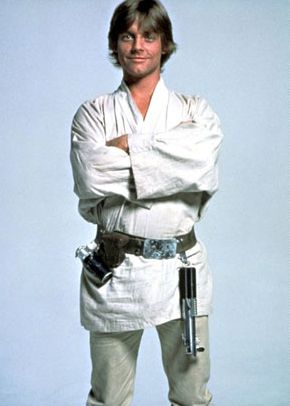
This goes beyond visuals; the same principle holds true of basic narrative, too. Consider this guy:


We’ve all heard more than we ever needed to about the “Hero’s Journey” and the “Monomyth” and all of Joseph Campbell’s theories in relation to Star Wars—which has, of course, become the template for much of pop culture. Well, what is “The Hero With A Thousand Faces” but a narrative application of the masking effect? Luke Skywalker’s a bland character—that’s not a bug, that’s a feature. He’s supposed to be a stand-in for the viewer, an empty vessel you can pour yourself into for a purer experience in narrative immersion.

Han Solo? There’s a character. He’s a specific person. Because of that, he works on a different level of narrative immersion—the kind that was more common before Star Wars came along. Because of course we want to be Han Solo. Why wouldn’t you? He’s awesome! He’s a badass smuggler who quips and flies a cool spaceship and gets the girl. Luke may have the awesome laser sword, but I’m guessing more little boys pretended to be Han.

So that blows my “masking” theory to shreds, right?

Not really. It’s just that Han represents a different philosophy of storytelling than Luke does. And here’s where we start getting to the root of an issue I have with modern pop culture wizards (because you knew I was going there eventually, right?)

Movies, in the olden days, strove more for Han-style characters. It’s not that there weren’t bland leads—Lord, were there ever!—but for the most part I don’t think they were trying for that. The idea was generally to produce textured characters who felt like real, which is to say, specific people. I do think there was some understanding of the masking effect, though it may have been rooted more in cultural concerns—of course the hero is going to be a square-jawed white guy—or marketing ones (as with the sudden shift to teenage heroes in the postwar years as they became a lucrative market). The idea of appealing to as broad a part of the population as possible isn’t some revelation, and “viewer insert” characters.

But there was something else at work: movies knew they set the trends for culture, and that people would look up to them to a certain extent. The people who made movies knew that if they could make X look cool, people would flock to X. Humphrey Bogart wasn’t an everyman. Marilyn Monroe wasn’t an everywoman. They were who they were, and people tried to be like them. Not vice versa. The movies, and thus pop culture, were dominated by the Han Solos.

This is one of many things Star Wars changed when everyone decided it was going to be the new bedrock for genre storytelling. The use of the masking effect was one of George Lucas’s triumphs, and it’s probably the single greatest reason that Star Wars was glommed onto as a formula—it (supposedly) provides a quick, easy way to make sure your audience of desirably young and cash-flush nerds can instantly relate to and love your story. Make your lead a bland everyman, and the viewer will fill in the blank themselves—with themselves. This is why, for instance, Harry Potter is such a blank slate, while his friends and teachers and enemies are so much more vivid characters. It’s why so many movies about other cultures are seen through the eyes of a white American, a la “Dances With Wolves”. And it’s why Hollywood is stocked full of blandly pretty leading men and women.

Perhaps you’ve noticed that I’ve gone from implicitly praising the masking effect to condemning it. In truth, the masking effect can be employed in far more sophisticated and complex ways. It’s shorthand, a nifty technique that can be laudable in the right hands. There’s nothing wrong with using a viewer insertion character to ease us into a strange world, for instance. But like so many useful artistic techniques, Hollywood has tried to reduce it to a formula, a crutch, or just an excuse to deliver vapid, bland characters. Perhaps more destructively, it’s led to a pop culture where so many protagonists are white heterosexual males in their late teens-early 30s without a distinctive job or any particularly strong beliefs, cultural background, or engagement in the world.

Because the problem is that we still crave Han Solos. Sure, we like being fooled into projecting ourselves into the role of a hero. But we can only be met halfway on this. On some level, when we read or watch stories, we’re looking for role models and aspirational figures. We need someone to admire. The masking effect essentially turns protagonists into mirrors—and thus, we’re constantly being told that we’re the heroes, if just for one day. (Not a coincidence that there are quote marks around that title!) As flattering as that may be, at the end of the day it becomes hollow, a deification of emptiness. If you keep portraying heroes who aren’t fully realized, who stumble through the world without viewpoints or ideas, who are only there to have things happen to them—then that’s the kind of figure people will start emulating.

But then, maybe that’s for the best. Those are exactly the kind of people who are easiest to sell movie tickets to. And everything else.

(I’ll have more to say on this subject after the holidays. Can you stand the suspense?!?)

Saturday, November 24, 2012

Treklife: This Is Not The Kirk I Was Promised


I only watched the classic Trek for the first time in its entirety a few years ago. As a TNG-loving teen I'd made a few attempts over the years, most notably dipping into a Trek marathon that aired on Canada's Space Station over...the holidays, I think? Or possibly while I was out of school, sick? I honestly don't remember, though being sick might explain my inability to engage with it. Or maybe that's just because I was, y'know, a teenager. Camp is the bane of teenagers, and TOS was campy even at the time it was made. I was outgrowing the kinds of clunky TV shows I'd uncritically consumed as a kid and embracing a whole new set of supposedly cooler shows, ones that offered more superficial appeal and engaged with my adolescent reptile thrill-seeking brain. You know the drill. You went through it yourself.

This dorky, extremely low-budget series with its hammy acting was too ripe for my newly minted sense of reflexive irony. I've actually always been a little more open towards older movies and TV shows than many, even as a kid, but Trek just didn't click. I think it might have been the fact that it was nominally connected to The Next Generation--instead of being free to be its own thing, I could only view it through the lens of the new show. I ended up sitting there and nitpicking how ridiculous the Klassic Klingons looked and trying to concoct reasons for why the Cardassians or the Ferengi weren't on anyone's radar back then.

As an older, "wiser" specimen, I've actually found my tastes becoming broader and my willingness to engage with art on its own terms expanding, and thus, with J. J. Abrams' reboot was threatening to hit the screens, I borrowed the box sets from a friend and delved in.

(My thoughts on Abrams' remake have cooled quite a bit, but I enjoyed it at the time, and in fact wrote this snotty review of Trek in general that ticked a lot of people off. I did mean it tongue-in-cheek, but yeah, that was kind of dickish of me. You should probably read that before continuing.)

I think one of the things that caused me to write that review--that caused me to fall away from Trek in the first place--was my reading about the backstage travails of how it came to the screen. You see, I really *believed* in the ideals of Trek. I still do. Exploration, rationality, communication and compromise, striving towards a better future. These have become a major part of my moral makeup, and Trek is a big part of why. And I was naive enough to believe that the show's creators shared these ideals.

But of course, it's just a fucking TV show.

It's not even some story of Hollywood backbiting that drove me off (though it became clear later that Rick Berman was quite a tool.) It was the underlying cynicism and laziness that was beginning to seep into the show, the way the writers didn't seem to care much about exploring the issues they raised anymore, the way continuity was shredded and characters treated callously. Basically, all the stuff I wrote about in my last post on the subject. But it was exacerbated by my growing awareness of the way TV shows were made.

Look, I'm aware that art isn't some perfect, pure process in which the muses flit down on wings of saffron and caress the artist's brow to provide inspiration, and even if it were the process of getting it to the screen would require change and compromise. I know that the ethereal, platonic magic that stirs your soul has to go through a mundane process of realization, which can be reduced to charts and graphs and scripts and outlines and formulas. All artists have a physical process. I know that now.

But at the time I felt deeply, deeply betrayed by uncovering Trek's relationship to showbiz, and combined with the way that, in the latter seasons of TNG, no one involved seemed to care all that much, it provoked a hostililty that lingered all the way to 2009, when I wrote that review.

So there's that.

Really, though, what I was still reeling from--and what I now find fascinating--is just to what degree classic Trek isn't the thing everyone seems to think it is.

We all know the litany: a post-scarcity future with prosperity and enlightenment for all. The Vulcan reverence for Logic. The Prime Directive. The emphasis on communication and co-operation. The glimpse of a better future for mankind. These are things that have a powerful appeal.

Which is why it's so astounding that the classic series was so conflicted about all this stuff.

Decades later, Roddenberry and the fans codified the above ideas as the core of Trek, and it's been that way since the movies. But the thing is, Roddenberry wasn't that great a writer, and he left a lot of the work to a talented team that seemed to have different ideas about what Trek would be. This clash of ideologies made it into everyone's Platonic ideal of the show to a degree, but Roddenberry's vision has been the one that prevailed.

Roddenberry clearly was a socialist democrat who believed in military adventurism (I’d argue he was more mainstream in the 60s, some of the more offbeat stuff that crept into his thinking–a slightly creepy collectivism, for instance–having come later) but the show had libertarian and counterculture writers as well. Likewise there are episodes like “The Way to Eden” which is pretty contemptuous of the youth culture of the time, yet a lot of other Trek stories seem to embrace it in more subtle ways, particularly the idea that there’s something ridiculous about authority and that love, peace and harmony can triumph over evil (and “Way of the Gun” sees the crew using passive resistance and an oddly Buddhist mindset to overcome violence.) There are episodes that can be read as both for and against the Vietnam war (which is really what the Prime Directive was about in the first place) and episodes that are both for and against organized religion.

As for Spock, he definitely seems to have been created as a straw man--someone to show the value of humanity and the perils of relying on logic entirely. And yet it doesn’t take too long before the writers seem to start siding with Spock on a lot of things–in fact, he almost seems to be the representative for the counterculture at times, his spirituality being almost as big a point as his logic. In “Space Seed” Spock is appalled to hear everyone else speaking well of Khan, and I can’t imagine we aren’t supposed to, at the very least, sympathize, if not completely agree. (And it’s interesting to me that the supposedly detached, logical character is the one taking the firm moral stance while the more emotional humans can admire the historical monster, if somewhat back-handedly; conventional storytelling would have flipped that to criticize Spock's logic, but here it seems like humanity is the one that’s in danger of falling under the sway of a charismatic figure.) Of course there are plenty of “silly Spock, there’s more to life than logic” episodes as well, but the character was no Agent Scully, there just to voice the “wrong” opinions. (Actually I’d argue even Agent Scully wasn’t an Agent Scully, but I’m drifting from the point here.)

Likewise, there's the idea of a post-scarcity society without money, which looms so large over discussions of Trek, but which barely seems present on the original series. It’s implied by the replicators and so on, but the way everyone’s needs seem to be taken care of could be chalked up just as much to the fact that this is a pseudo-military organization as to anything else. Isn’t there discussion of mercantile arrangements in the early episodes? Isn’t Harry Mudd basically a con artist? What’s he swindling people out of if not their money? And I could have sworn Scotty or someone mentioned getting paid, though of course he could have been speaking figuratively.

Finally, there's the Prime Directive. The fact that Kirk violated the Directive practically every week is, by now, a cliche, but what's even more interesting is that, looking at the original series in isolation I honestly couldn’t tell you if the writers meant for it to be seen as a good thing or a bad thing. It often seems more like a dramatic obstacle than a philosophy, something that was just there so that Kirk could show off what a badass renegade he was--the Cop Who Plays By His Own Rules transposed into the 23rd century. And indeed, Starfleet in general seems to be heavily populated with stiff bureaucrats who exist only to make Kirk's life miserable.

Utopian future? I don't think so.

It's a fascinating series precisely because of these contradictions, and it's ironic that the show's own creator asserting his creative vision arguably produced something less interesting. It's certainly a handy riposte to people who think Trek's vision of a relentlessly positive future is naive or unworkable: that vision never really existed...


Wednesday, November 21, 2012

In Praise of Mediocrity


So Star Wars.

Someone tweeted recently (sorry, I can't remember who or I'd attribute it) that there was no better exemplar of the human capacity for optimism than the speed at which "New Star Wars" went from a punchline to a prayer. It's particularly bizarre when you consider that this is inspired by the series creator very deliberately bowing out of being directly creatively involved and handing over control to a massive multinational corporation. Seriously, that sentence I just wrote, divorced from context, makes me want to jump off the nearest balcony.

But blow me if the recent proceedings haven't been filling me with a thrill of hope. In spite of everything, Star Wars is still something I care about--not the merchandising and spinoffs and gubbery per se, but the original three films. I still think they're an incredible feat of filmmaking and resonate with me on a primal level that I'll never be able to put aside entirely, for all the intellectual arguments (many of which I accept) for how lame and culturally reactionary they are, how they damaged film as an artform and turned SF and Fantasy from the genres of imagination and ideas to a bunch of formulaic whizz-bangery. They still work, goddammit. And the chance of getting more that might work on the level that the classic films do is something that can legitimately get me excited.

To be clear here, I'm not the kind of nerd who wants everything they love on endless replay forever. I was honestly kind of "blah" in the lead-up to The Avengers (which may be why I was able to walk in with reasonable expectations and legitimately enjoy it), I thought the Chris Nolan Batman films probably should have ended with The Dark Knight, and I honestly was not feeling any particular excitement about The Hobbit even before they announced that it was going to be split pointlessly into three films. I can get very excited by the upcoming work of a particular filmmaker, but "franchises" do little or nothing for me.

What's more, I 100% agree with what a number of people are saying, that some of the directors that the nerderati* are excitedly suggesting to helm the new movies are inappropriate because they're too interesting and creative and they don't deserve to be shackled to a massive franchise that will limit their creativity. It's true that Sam Raimi and Chris Nolan were able to bring their talents to bear on major comic-book superhero movies and leverage them into other great movies, but other cinematic talents haven't fared nearly as well. I thought Brian Singer was a legitimately promising director who did a great job with his X-Men films, but somehow jumped the shark in a major way starting with Superman Returns. Peter Jackson was a favourite of mine in the 90s, but Lord of the Rings seems to have sucked him dry of his reckless imagination and ballsiness. Jon Favreau's career suffered major diminishing returns after Iron Man. And I'm honestly kinda worried about Joss Whedon now**.

*Is that a new word? Did I just create that? Patent pending!

**Yeah, I still like Joss Whedon. Fuck you.

Favreau's name has been floated as a likely candidate to direct Star Wars episode VII, though, and I actually think he'd be perfect. This is yet another of the bizarrely paradoxical aspects of how interested I am in this whole announcement. I want certain filmmakers to keep away from new Star Wars for their own sakes, but oddly, I kind of want it for the sake of Star Wars, too.

Because what works about Star Wars is something very simple and pure. It's become a cliche, but Star Wars really does tap into some of the primal urge for myth-making that we've felt since we were hairy grunting jerks huddled around a campfire, and it weds it both to the old-Hollywood desire to entertain and the geeky proclivity for world-building. It's not about re-inventing cinema, it's about stripping it down to its essence and then encrusting it with a lot of entertaining bric-a-brac. The elegance with which the OT captures this "mythical modern" feel--something that the Prequels quite spectacularly failed to do, of course, and for all that people tear apart the Prequels, that particular shortcoming is rarely mentioned--requires a certain kind of talent to capture. It's very definitely not the province of visionary artists; it's more like the sphere of extra-competent journeymen who somehow capture lightning in a bottle.

Take, for example, Michael Arndt, who's apparently been hired as head writer for the new trilogy. (Lawrence Kasdan, co-writer of The Empire Strikes Back and Return of the Jedi, was recently announced as probably writing Episode VIII, along with Simon Kinberg, but they're likely to be working from Arndt's outline.) Arndt wrote Little Miss Sunshine, which is a movie I really don't care for. The performances slightly elevate it, but the script is an incredibly cynical and rather formulaic attempt to imitate a "quirkie indie comedy". And yet, somehow, it's these qualities that make me think Arndt's going to be just right for new Star Wars movies. You don't need to have authenticity to write Star Wars. If anything, I feel like that would just get in the way. What you need is a rock-solid understanding of the basics of storytelling, and how to get past your audiences' defenses and give them what they want. To pander, if you will.

Arndt's apparently taught screenwriting classes using Star Wars as a model for great story structure. He's not wrong. I don't really want this guy within twelve miles of a movie that has a shot at challenging the audience or subverting the rules of drama, but from what little I know about the guy, handing him the keys to Star Wars feels like destiny.

Which brings me to Favreau. A number of similar journeyman directors have been suggested for this--Joe Johnston, Brad Bird (who's already begged off), Matthew Vaughn. Those are all pretty suitable choices, filmmakers with solid storytelling skills who've mostly been content to stay within the realm of crowd-pleasing spectacle, but who do so very well. Favreau has a couple of extra points in his favour, though: for one thing, he's the first director in a decade to get an actual performance out of Harrison Ford (who I'm really hoping will make one last visit to the Star Wars universe, if only to give Han Solo the send-off he deserves). He also has a great philosophy of special effects, having stated on multiple occasions that it's important not to rely on CGI alone, and that stuff like puppetry and stop-motion can still have a place in modern movies, as demonstrated by his rather charming SF kid's movie Zathura. That sounds like an ideal fit with Star Wars, which showcased some of the wondrous things that can be done with practical effects, before ironically sinking into a quagmire of halfassed CGI with the prequels. Since the visuals and effects are an important part of Star Wars, having Favreau in charge would be genuinely exciting to me. Imagine, this series that set the tone for special effects becoming a celebration of the retro.

Mostly, though, I like Favreau for this because, even at his worst, he's always understood the need to bring humanity to the biggest blockbusters--and humanity is something that Star Wars has lost rather badly over the decades.

So essentially, with the new Star Wars movies, we have a weird situation where a ton of individual elements that I don't like very much seem weirdly likely to come together to produce something great.

Or it could end up sucking really, really badly.

I have to admit that the latter is every bit as likely as the former. But hey. It's been an increasingly depressing decade for nerd culture. If something like this stirs the embers of optimism in me, no matter how inexplicably, I think it deserves credit for that.

Thursday, November 15, 2012

A Life In Trek


Hi! Miss me?

It’s been a tumultuous six months or so for me, encompassing a move, a new job and a whackload of freelance projects, and this blog has seemed like something that’s easy enough to shrug off. But I’m finding myself wasting so much time on Twitter and various message boards that I might as well post my thoughts on stuff here instead. Plus, I’m trying to get more serious as a writer and attempting regular blog posts is a good way to discipline myself.

So anyway, let’s talk about Star Trek.

***

Star Trek: The Next Generation was the pop cultural equivalent of my first adolescent crush. I’d loved TV shows before that, in much the same way that you love people as a small child, largely because they are present and bringing you food. TNG was the first show that was “mine” properly speaking—the first pop cultural artifact that I actively sought out and became properly obsessed over.

And I do mean obsessed. I think my interest in the show coincided with it becoming syndicated for the first time, though I was too young to be sure about that. I think I started out somewhere in the second season, because I specifically remember seeing the first season for the first time and thinking how cheesy it looked and how much the show had evolved. I watched those first three seasons on a freaking loop—I taped them and rewatched them every day, and I absolutely had to be home to watch the syndicated rerun no matter how many times I’d seen the episode before. I bought all the spinoff novels (fortunately there weren’t too many of those to blow my money on) and most of the technical manuals, alien race guides, and eventually the TNG Companion became one of my proudest possessions. I wrote up elaborate encyclopedia-style listings of the various alien races, planets, and technology (thank God the internet wasn’t really a thing back then…though, wait, is the fact that I wrote these for my own amusement more or less sad than creating a Wiki?) It got so I could identify an episode by watching the first couple of seconds and…sigh, yes...hearing Picard recite the Stardate.


So yeah, pretty damn nerdy.

What’s weird about this is that I never really felt compelled to check out the original series. Part of that was that I don’t think it was airing in syndication on any of the channels I received at the time, or at least, nowhere that was convenient for me. My ten-year-old brain was wired kind of weirdly. I’d religiously plunk myself down in front of the TV right after school and watch cartoons, old sitcoms, and TNG, but I rarely felt compelled to watch in the evening.

Until, of course, I twigged to the fact that there were actual NEW EPISODES of TNG airing later in the evening (along with some other shows, like that “Simpsons” thing my VCR-obsessed family friend used to show me whenever I came over). I had discovered…Prime Time.

(Look, I’ve lived a very boring life, OK? Without exaggerated pomposity my autobiography’s going to be basically unreadable.)

Friday nights at 10, the night that TNG aired, became appointment television for me and my family—because I of course sucked them into it too. I’m always a little amazed at how my sisters, especially, picked up my pop cultural obsessions, for all that they acted like I was annoying them at the time; one of them can still remember albums worth of Weird Al lyrics, and the other owns an enormous prestige hardcover collection of Sandman and V For Vendetta. I’m contagious!

As for my parents, my dad likes anything tech-heavy, and my mom (a British ex-pat) likes watching theatrically trained Brit actors go at it. Of course my dad especially couldn’t help making snarky remarks through some of the show’s worst excesses, particularly the often stiff acting, but hey, family bonding is family bonding.

Oddly, it was around the time that Deep Space Nine spun off that I started to sour on Trek. Believe it or not, DS9 is the reason I’m delving into this whole subject, which is going to take up several blog posts—I’ve been working my way through it recently—but at the time, I found myself developing an aversion to it pretty fast, despite the slick production values. Part of it might be that I couldn’t interest the rest of my family in it, so I was watching it alone for season two. But another part of it was that that obsessive childhood brain of mine—man, this is really making me sound like I have OCD or something, isn’t it?—had fixated on what I thought were the “rules” of Trek, and DS9 was starting to break those rules. You can’t really blame me; this obsession with Trek was partly about me discovering how stories were told, visually and textually, and of course there’s no-one who gloms onto formulas like a student adrift in the vast, scary sea of creativity. But at the time it seemed like a betrayal. More on that anon.

Anyway, this was actually pretty small potatoes, if interesting in retrospect; the real issue was that the cracks were starting to show in TNG for me. The laziness of their treatment of aliens was a huge factor, for a start. I’m not just talking about the lameness of those infamous “bumpy forehead” designs (which were partly a budget issue, after all—even as a kid I understood these guys didn’t have George Lucas’s budget). It was the way the word “alien” never seemed to mean anything to the Trek writers. Aside from Klingons, Borg, and a handful of others, every alien species on this show spoke, acted, and emoted like a human being, and that’s just lame writing. It didn’t help that most of them appeared for a single episode and then vanished, never to be heard from again, which didn’t exactly help build a rich and detailed world. Likewise, the show’s continuity started to seem slapdash; I was interested in the “nodular” nature of TV storytelling at the time, but even then I thought it was a bit of a ripoff that so many major ideas could get sidelined and even abandoned. I mean are Trill people with weird foreheads or with dots down their necks I ASK YOU TREK PRODUCERS.

Ahem. I did mention that I was a nerd, right?

My list of problems with the show started to pile up until it was at least as large as the stuff I liked about it—something that’s become part of my makeup as a fan, unfortunately—but I kept watching all the way through to the finale, “All Good Things…” which I remember being really very good. And then that was that.

I think part of me knew it was in my best interests to make a clean break from Trek, and I even recall a vague sense of relief. Take this geeky burden from off me, Lord! Not that I hadn’t found new geek interests—I think The X-Files had grabbed most of my attention at the time, concurrent with Batman: The Animated Series--and those distracted me long enough to keep me from re-visiting TNG.

When I finally decided to start catching up on Trek a few years back, I made a conscious decision NOT to watch TNG, and in fact I don’t plan to ever revisit the show. I’m not the kind to wallow in nostalgia (ask me about Transformers sometime, and how my childhood love for them quickly became bemusement, leading into seething hatred thanks to the likes of Michael Bay) but Star Trek: The Next Generation seems to be the embodiment, for me, of a memory that the real thing will never be able to match.

Thursday, April 5, 2012

Pop Culture Will Eat Itself


I haven’t been making much use of this blog lately, and it’s not because I don’t want to—just the opposite. I keep coming up with ever more elaborate and baroque ideas for blog essays, many of them part of a putative in-depth series, but my problem is that I never want to launch into them without getting my ideas organized first. Clearly this is leading to literary paralysis, so I’ve decided to just launch into a post, or series of posts, and let it develop as it comes. All of this is to say, if the following seems somewhat on the vague side, you may understand why.

Aaaaaanyway.

Being a geek on the internet, I can’t help but notice the contentious tone that’s settled into fandoms of various stripes. (Thank you, doctor obvious.) I choose to stay away from the more sordid corners of the net and cleave to the more intelligent and thoughtful writers on pop culture, but that doesn’t mean I’m more likely to avoid contentiousness. Just the opposite, in fact. Some of the smartest and most insightful bloggers in geekdom, or any subdomain thereof, have (often delightfully) acid tongues. But there’s an interesting attitude that’s been forming for a while now among the nerd literati—the desire to inject some much-needed self-awareness into the culture of geekdom through criticism. There’s no getting around the fact that the more ravening segments of fandom have gotten out of control, feeding a sense of entitlement grown ludicrously bloated (see, for example, the petition or whatever it was to change the ending of Mass Effect 3) and bizarre tribalism centered around serving the finances of huge corporations (here see the decision by many geeks to side with Marvel against the Kirby heirs, or, slightly less toxically, the caterwauling over The Dark Knight’s failure to win Best Picture or beat Titanic at the box office.) And of course, it’s become de rigeur for nerds to reject considered criticism of their Favourite Thing as a mortal insult that cannot be allowed to stand, leading to an unfortunate watering down of serious analytical reviews. In the face of all this, an attitude of contempt and disdain towards geekdom is not only understandable but often laudable.

And yet.

A knee-jerk attitude from an intelligent contrarian standing against mindless groupthink is nevertheless a knee-jerk attitude, and I feel like we’re starting to see some negative blowback. Essentially, there’s an ultra-defensive elitist mindset forming that seems to feel they can take it for granted that [pop culture property X] is a waste of time propagated by the dregs of the net, and that anyone who speaks up in its defense is by default an unwashed, unselfaware nerd. This is the “Oh, now a bunch of NERDS are gonna complain that I dissed Arkham Asylum” response, and it seems to tilt perilously close to shutting down debate just as the rabid hordes of fanboyism do. If you post your thoughts on the internet, you’re likely to find people disagreeing with you; that’s sort of the point of the internet.

But I didn’t really want to talk about the Great Nerd Wars in particular, I wanted to investigate a particular aspect of this attitude: namely, the way some pop culture properties are elevated above others, both in the short term and the long term.

Here is a list of things:

--Lord of the Rings.
--Mass Effect.
--Marvel Comics.
--DC Comics.
--Watchmen.
--Scott Pilgrim.
--Firefly.
--Game of Thrones.
--The Wire.
--Star Trek.
--Doctor Who.
--Star Wars.
--The Prisoner.
--My Little Pony.
--Rap music.
--They Might Be Giants.
--The Beatles.
--The Coen Brothers.
--David Cronenberg.
--Joss Whedon.
--Rob Zombie.
--The Boston Red Sox.

I’m guessing that you see that as a pretty varied list—I don’t just mean your personal likes and dislikes, I mean that these all seem to occupy wildly different places in the pop cultural sphere. Some of them are “classics”, part of the canon of the 20th or earlier 21st century, and some of them are trash culture or ephemeral entertainments, and some fall somewhere in between. I bet your mind sorted them out to an almost subconscious degree. And yet, all of these are the subject of passionate pop cultural fandoms—what we’ve collectively decided to refer to as “geekdom”. Some of these aren’t thought of as “geeky” per se, and yet the passion they engender seems very much of the same quality. And to a degree, it’s rather surprising that we separate them in this way.

Please understand, I am NOT trying to make an argument that everything’s subjective, as a springboard to excusing my own taste’s or anyone’s. This might seem like the first step down the path towards the argument that Citizen Kane and The Transformers Movie are both equally valid works of art*, and that isn’t my intention. I’m just saying that these properties all have essentially the same qualities, in the scientific sense; they’re all, fundamentally, the same kind of thing. So why are some easily dismissable and require a burden of proof from anyone trying to argue in their favour, while others demand to be taken seriously, even by their detractors?

Look at Lord of the Rings, which is the one thing on this list that could potentially escape this little Pop Culture Ghetto I’ve devised. (And I think “ghetto” is precisely the wrong word for it, but let’s leave it for now.) LOTR was written as a sideline, a hobby of sorts, by a literary professor with a day job. It was his life’s work, and it was produced as an artistic statement rather than an attempt to make money or win an audience**, and it’s had a significant literary impact; it wouldn’t be unreasonable to elevate it to the position of “literature”. But it’s a work of pop culture, too, one whose fanbase and impact are very much in the same mode as all the others on this list, if perhaps more literate and thoughtful than the average Rob Zombie fan.

…And see, there I go—knee, jerking away. The fact that I personally find Tolkien’s work to be more deserving of merit than Mr. Zombie’s oeuvre doesn’t mean that I somehow “outrank” them. Or that LOTR doesn’t occupy the same nerdosphere. I know for a fact there are supremely intelligent horror fans out there who have elegant arguments in favour of The Devil’s Rejects, and I know just as surely that there are some awful dimwits out there who love LOTR and think that that alone makes them discriminating and classy.

“Classy”. That might be a useful word for this discussion.

I actually don’t want to dwell too much on Tolkien, because he’s something I’ve been wanting to blog about in depth and I’ll probably have lots to say in another series of posts, but for now my question is this: If Tolkien had come along a decade or two later, would we be as quick to elevate him above stuff like Star Trek? That’s not a knock on Tolkien so much as it is an elevation of everything else; after all, Star Trek was an intelligent, ambitious show. But it also shares with Tolkien, and the rest of my little canon there, a world of arcane details to which the fans have developed an attachment beyond mere entertainment. They even share made-up languages that have spawned real-world speakers.

Let’s move on to something closer to the other end of the scale, or rather two things: Doctor Who and old Superhero comics. These are two properties to which my exposure was limited as a kid, but in which I began to take an interest as an adult partly because they have so many intelligent defenders, particularly on the web. Neither of them escapes being seen as a “nerdy” pursuit by the mainstream, or as silly or inaccessible to outsiders, and yet, within geekdom, both are taken relatively seriously. There’s an underlying belief that there are fundamentally interesting and intelligent stories to be told by these properties, and the people who blog passionately about them are able to articulate these arguments more than most fandoms. They are, to return to the word, “classy”, in a way that 80s cartoons and video games aren’t. And yet, it’s often hard to argue for the merits of a given Silver Age comic or an early-80s episode of Who, which are not only frequently threadbare or slapdash, they’re often outright nonsensical. Even stupid. And it’s not like the defenders of these two properties will argue otherwise. So what makes these particular pop cultural emanations “classier” than others?

To be continued….

*Well, I’m not going to refuse to entertain such an argument if it’s well-reasoned enough, but that would have to be one hell of an argument. “They both have Orson Welles in them” might not be the place to start.

**Probably a drastic oversimplification, but it’s surely not unfair to say that Tolkien wasn’t really dreaming of tearing up the paperback bestsellers list, right?