Showing posts with label Thank You George Lucas. Show all posts

Saturday, December 22, 2012

Mirror, Mask

There’s a phenomenon I’ve been fascinated with ever since I first had it elucidated for me in Scott McCloud’s “Understanding Comics”. McCloud calls it “the masking effect”.

Basically, cartoons can achieve a kind of universality that isn’t directly available to any other medium, through their sheer simplicity. We’re visual creatures, and to us the world outside is a rich, textured environment, and the people we deal with every day are distinguished via the details that we slowly become familiar with. Other people are something we observe, and take on an elaborate shape in our minds. But, McCloud says, most of us aren’t nearly as familiar with our own face, because we only see it comparatively rarely. To us, on the other side of the mask, our face exists more as a concept, or a series of non-visual sensations. We imagine the basic placement of eyes, mouth, nose, but we don’t connect it in a concrete way with how we look at any given moment. We don’t picture our freckles or pores or the spot we missed shaving, whereas to anyone encountering us these are prominent features. Everyone else is part of the physical architecture, but we exist to ourselves in an almost Platonic, semi-abstract state.

In other words, a simple, undetailed cartoon rendering of a face is a reasonably close approximation of how we see ourselves, and for this reason, McCloud argues, we’re far more likely to project ourselves onto it. The more details you add, the more potential there becomes for the image to break with how you see yourselves, and the more layers of potential detachment you’ve now added to the character. A smiley face could be literally anyone, of any race, age, gender. A detailed drawing of, say, Wonder Woman is a specific person, one with whom you’re likely to have certain differences.

Obviously that doesn’t mean you can’t relate to, or like, a detailed character; it’s just that that, unless you’re a statuesque Amazon brunette, that lavishly rendered Wonder Woman is someone else. The smiley face is YOU.

Of course books take you even more deeply into the character’s heads, but in the kind of story in which we can actually SEE our protagonist, only cartooning really allows for this “pure” a level of projection. But of course this whole principle exists along a continuum: a character played by an actor, for instance, presents us with a specific person, who, by definition, isn’t “us”. However, if the actor is a white male, it’s statistically more likely (in North America) that we’ll be able to project ourselves onto that character than if the actor is a black woman, for instance.

Yes, this is a ludicrous oversimplification that completely discounts the ability of humans to feel empathy for someone different. This is actually part of what I want to talk about. But for now, as relates to the “masking” effect, the idea is that the more universal the character, the more heightened the ability one has to project yourself onto them. Once you cast an actor to play your character, you’re limiting the ability of some of your audience to literally see themselves in their shoes in this way, but you can still trend towards the most “universal” type of look, be it in terms of race, gender (you’ve instantly got to discount 50% of the population there, no matter which way you go!), age, height, weight, etc. etc. etc.

And yeah, I think you may be getting an inkling of why this is a problem.

This goes beyond visuals; the same principle holds true of basic narrative, too. Consider this guy:
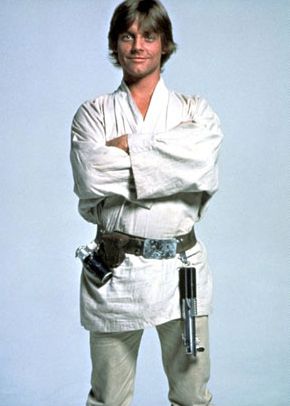


We’ve all heard more than we ever needed to about the “Hero’s Journey” and the “Monomyth” and all of Joseph Campbell’s theories in relation to Star Wars—which has, of course, become the template for much of pop culture. Well, what is “The Hero With A Thousand Faces” but a narrative application of the masking effect? Luke Skywalker’s a bland character—that’s not a bug, that’s a feature. He’s supposed to be a stand-in for the viewer, an empty vessel you can pour yourself into for a purer experience in narrative immersion.

Han Solo? There’s a character. He’s a specific person. Because of that, he works on a different level of narrative immersion—the kind that was more common before Star Wars came along. Because of course we want to be Han Solo. Why wouldn’t you? He’s awesome! He’s a badass smuggler who quips and flies a cool spaceship and gets the girl. Luke may have the awesome laser sword, but I’m guessing more little boys pretended to be Han.

So that blows my “masking” theory to shreds, right?

Not really. It’s just that Han represents a different philosophy of storytelling than Luke does. And here’s where we start getting to the root of an issue I have with modern pop culture wizards (because you knew I was going there eventually, right?)

Movies, in the olden days, strove more for Han-style characters. It’s not that there weren’t bland leads—Lord, were there ever!—but for the most part I don’t think they were trying for that. The idea was generally to produce textured characters who felt like real, which is to say, specific people. I do think there was some understanding of the masking effect, though it may have been rooted more in cultural concerns—of course the hero is going to be a square-jawed white guy—or marketing ones (as with the sudden shift to teenage heroes in the postwar years as they became a lucrative market). The idea of appealing to as broad a part of the population as possible isn’t some revelation, and “viewer insert” characters.

But there was something else at work: movies knew they set the trends for culture, and that people would look up to them to a certain extent. The people who made movies knew that if they could make X look cool, people would flock to X. Humphrey Bogart wasn’t an everyman. Marilyn Monroe wasn’t an everywoman. They were who they were, and people tried to be like them. Not vice versa. The movies, and thus pop culture, were dominated by the Han Solos.

This is one of many things Star Wars changed when everyone decided it was going to be the new bedrock for genre storytelling. The use of the masking effect was one of George Lucas’s triumphs, and it’s probably the single greatest reason that Star Wars was glommed onto as a formula—it (supposedly) provides a quick, easy way to make sure your audience of desirably young and cash-flush nerds can instantly relate to and love your story. Make your lead a bland everyman, and the viewer will fill in the blank themselves—with themselves. This is why, for instance, Harry Potter is such a blank slate, while his friends and teachers and enemies are so much more vivid characters. It’s why so many movies about other cultures are seen through the eyes of a white American, a la “Dances With Wolves”. And it’s why Hollywood is stocked full of blandly pretty leading men and women.

Perhaps you’ve noticed that I’ve gone from implicitly praising the masking effect to condemning it. In truth, the masking effect can be employed in far more sophisticated and complex ways. It’s shorthand, a nifty technique that can be laudable in the right hands. There’s nothing wrong with using a viewer insertion character to ease us into a strange world, for instance. But like so many useful artistic techniques, Hollywood has tried to reduce it to a formula, a crutch, or just an excuse to deliver vapid, bland characters. Perhaps more destructively, it’s led to a pop culture where so many protagonists are white heterosexual males in their late teens-early 30s without a distinctive job or any particularly strong beliefs, cultural background, or engagement in the world.

Because the problem is that we still crave Han Solos. Sure, we like being fooled into projecting ourselves into the role of a hero. But we can only be met halfway on this. On some level, when we read or watch stories, we’re looking for role models and aspirational figures. We need someone to admire. The masking effect essentially turns protagonists into mirrors—and thus, we’re constantly being told that we’re the heroes, if just for one day. (Not a coincidence that there are quote marks around that title!) As flattering as that may be, at the end of the day it becomes hollow, a deification of emptiness. If you keep portraying heroes who aren’t fully realized, who stumble through the world without viewpoints or ideas, who are only there to have things happen to them—then that’s the kind of figure people will start emulating.

But then, maybe that’s for the best. Those are exactly the kind of people who are easiest to sell movie tickets to. And everything else.

(I’ll have more to say on this subject after the holidays. Can you stand the suspense?!?)

Wednesday, December 5, 2012

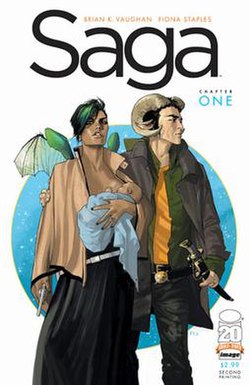
Comics Quickies: Saga


I'm strangely conflicted about Brian K. Vaughn as a writer. It's not that I don't like his comics; indeed, his work is usually a must-buy for me. But as much as I enjoy his stuff while I'm reading it, in the days afterwards there's always a cascade of "refrigerator moments" where the narrative logic starts to fray, or I start to find some of his narrative cutesiness and SHOCKING TWISTS annoying or cheap in retrospect. But the biggest criticism I have of him is that he's one of these guys who feels like he'd rather be writing for TV or movies--indeed, Vaughn wrote multiple episodes of LOST--and this sensibility mars his comics somewhat. As propulsive and page-turning as they are, the pacing and structure is pure TV, with little attempt to make use of the medium of comics. Even the visuals in his comics tend to be pretty low-key and mundane, relying heavily on naturalism, real-world reference, and the "acting" of his characters. To his credit, he almost always pulls this off, which is a testament to the quality of the artists he's worked with as much as his writing, but it's disappointing to see his focus lie so far from the kind of stuff comics can achieve.

Which is what's refreshing about Saga. This new epic SF/fantasy hybrid comic sees Vaughn stepping well outside his comfort zone, tackling more grandiose and comic-y subject matter, and even starting to take advantage of the visual possibilities of the medium in a way he generally doesn't. Some of the credit here must surely go to his artist, Fiona Staples, whose style is looser and more expressionistic than Y: The Last Man's Pia Guerra or Ex Machina's Tony Harris, but there's an overall feeling that Vaughn is stretching himself, too, creating narrative captions that are scrawled diagrammatically across the panels, robots who communicate their inner thoughts by flashing pictures on their TV-screen heads, and an unrelentingly fantastical universe full of weird imagery.

Though set against the backdrop of an intergalactic war and filled with pulp SF tropes like spaceships, robots, bounty hunters and pleasure planets, Saga is really a fantasy story in the sprawling, multi-book mode we're all familiar with. It opens with the narrator's birth, which makes it safe to assume that events will be playing out over an extensive period of time, and possibly spanning multiple generations, as the title would suggest. For now, the focus is on Marko, a horned magic-user, and Alana, a winged high-tech warrior, whose planets are at brutal, unending war. The two have defied their respective governments by falling in love, marrying, and producing a child, and now they're on the run across the planet, and eventually the galaxy, pursued by bounty hunters and a member of a strange, as-yet-unexplained robot royal family. The world Vaughn creates is rich and detailed and full of imagination, setting a grand stage for years of adventures to come, and his characterizations are more heartfelt than usual (though Alana can sometimes fall into the reflexive, hipper-than-thou posturing a lot of Vaughn's characters are guilty of). Vaughn has, ironically, stretched himself by embracing what could be considered a more traditional "comic book world", and the results are quite appealling. While the cynic in me is positive Saga will eventually fall prey to the slightly rushed and credibility-straining plotting that dogged Y and Ex Machina (though admittedly it never completely derailed either of those series), for now, Saga is another typically strong start for Vaughn, and an interesting promise of something different than what he usually offers.

Wednesday, November 21, 2012

In Praise of Mediocrity


So Star Wars.

Someone tweeted recently (sorry, I can't remember who or I'd attribute it) that there was no better exemplar of the human capacity for optimism than the speed at which "New Star Wars" went from a punchline to a prayer. It's particularly bizarre when you consider that this is inspired by the series creator very deliberately bowing out of being directly creatively involved and handing over control to a massive multinational corporation. Seriously, that sentence I just wrote, divorced from context, makes me want to jump off the nearest balcony.

But blow me if the recent proceedings haven't been filling me with a thrill of hope. In spite of everything, Star Wars is still something I care about--not the merchandising and spinoffs and gubbery per se, but the original three films. I still think they're an incredible feat of filmmaking and resonate with me on a primal level that I'll never be able to put aside entirely, for all the intellectual arguments (many of which I accept) for how lame and culturally reactionary they are, how they damaged film as an artform and turned SF and Fantasy from the genres of imagination and ideas to a bunch of formulaic whizz-bangery. They still work, goddammit. And the chance of getting more that might work on the level that the classic films do is something that can legitimately get me excited.

To be clear here, I'm not the kind of nerd who wants everything they love on endless replay forever. I was honestly kind of "blah" in the lead-up to The Avengers (which may be why I was able to walk in with reasonable expectations and legitimately enjoy it), I thought the Chris Nolan Batman films probably should have ended with The Dark Knight, and I honestly was not feeling any particular excitement about The Hobbit even before they announced that it was going to be split pointlessly into three films. I can get very excited by the upcoming work of a particular filmmaker, but "franchises" do little or nothing for me.

What's more, I 100% agree with what a number of people are saying, that some of the directors that the nerderati* are excitedly suggesting to helm the new movies are inappropriate because they're too interesting and creative and they don't deserve to be shackled to a massive franchise that will limit their creativity. It's true that Sam Raimi and Chris Nolan were able to bring their talents to bear on major comic-book superhero movies and leverage them into other great movies, but other cinematic talents haven't fared nearly as well. I thought Brian Singer was a legitimately promising director who did a great job with his X-Men films, but somehow jumped the shark in a major way starting with Superman Returns. Peter Jackson was a favourite of mine in the 90s, but Lord of the Rings seems to have sucked him dry of his reckless imagination and ballsiness. Jon Favreau's career suffered major diminishing returns after Iron Man. And I'm honestly kinda worried about Joss Whedon now**.

*Is that a new word? Did I just create that? Patent pending!

**Yeah, I still like Joss Whedon. Fuck you.

Favreau's name has been floated as a likely candidate to direct Star Wars episode VII, though, and I actually think he'd be perfect. This is yet another of the bizarrely paradoxical aspects of how interested I am in this whole announcement. I want certain filmmakers to keep away from new Star Wars for their own sakes, but oddly, I kind of want it for the sake of Star Wars, too.

Because what works about Star Wars is something very simple and pure. It's become a cliche, but Star Wars really does tap into some of the primal urge for myth-making that we've felt since we were hairy grunting jerks huddled around a campfire, and it weds it both to the old-Hollywood desire to entertain and the geeky proclivity for world-building. It's not about re-inventing cinema, it's about stripping it down to its essence and then encrusting it with a lot of entertaining bric-a-brac. The elegance with which the OT captures this "mythical modern" feel--something that the Prequels quite spectacularly failed to do, of course, and for all that people tear apart the Prequels, that particular shortcoming is rarely mentioned--requires a certain kind of talent to capture. It's very definitely not the province of visionary artists; it's more like the sphere of extra-competent journeymen who somehow capture lightning in a bottle.

Take, for example, Michael Arndt, who's apparently been hired as head writer for the new trilogy. (Lawrence Kasdan, co-writer of The Empire Strikes Back and Return of the Jedi, was recently announced as probably writing Episode VIII, along with Simon Kinberg, but they're likely to be working from Arndt's outline.) Arndt wrote Little Miss Sunshine, which is a movie I really don't care for. The performances slightly elevate it, but the script is an incredibly cynical and rather formulaic attempt to imitate a "quirkie indie comedy". And yet, somehow, it's these qualities that make me think Arndt's going to be just right for new Star Wars movies. You don't need to have authenticity to write Star Wars. If anything, I feel like that would just get in the way. What you need is a rock-solid understanding of the basics of storytelling, and how to get past your audiences' defenses and give them what they want. To pander, if you will.

Arndt's apparently taught screenwriting classes using Star Wars as a model for great story structure. He's not wrong. I don't really want this guy within twelve miles of a movie that has a shot at challenging the audience or subverting the rules of drama, but from what little I know about the guy, handing him the keys to Star Wars feels like destiny.

Which brings me to Favreau. A number of similar journeyman directors have been suggested for this--Joe Johnston, Brad Bird (who's already begged off), Matthew Vaughn. Those are all pretty suitable choices, filmmakers with solid storytelling skills who've mostly been content to stay within the realm of crowd-pleasing spectacle, but who do so very well. Favreau has a couple of extra points in his favour, though: for one thing, he's the first director in a decade to get an actual performance out of Harrison Ford (who I'm really hoping will make one last visit to the Star Wars universe, if only to give Han Solo the send-off he deserves). He also has a great philosophy of special effects, having stated on multiple occasions that it's important not to rely on CGI alone, and that stuff like puppetry and stop-motion can still have a place in modern movies, as demonstrated by his rather charming SF kid's movie Zathura. That sounds like an ideal fit with Star Wars, which showcased some of the wondrous things that can be done with practical effects, before ironically sinking into a quagmire of halfassed CGI with the prequels. Since the visuals and effects are an important part of Star Wars, having Favreau in charge would be genuinely exciting to me. Imagine, this series that set the tone for special effects becoming a celebration of the retro.

Mostly, though, I like Favreau for this because, even at his worst, he's always understood the need to bring humanity to the biggest blockbusters--and humanity is something that Star Wars has lost rather badly over the decades.

So essentially, with the new Star Wars movies, we have a weird situation where a ton of individual elements that I don't like very much seem weirdly likely to come together to produce something great.

Or it could end up sucking really, really badly.

I have to admit that the latter is every bit as likely as the former. But hey. It's been an increasingly depressing decade for nerd culture. If something like this stirs the embers of optimism in me, no matter how inexplicably, I think it deserves credit for that.

Tuesday, June 22, 2010

The Worst Of All Possible Worlds

In the early sound era, there was a mania for sequelizing and remaking movies; the Wizard of Oz that we know best is something like the fifth or sixth film version, and there was a sequel to King Kong made the same year the first one came out.

In the 50s, movies were often talky and stagey, stuffed with needless filler to pad out the runtime on business that wasn't at all important to the story, and with exposition often delivered in spectacularly clumsy fashion.

In the 60s, movies got incredibly bloated, with studios lavishing hundreds of millions of dollars (adjusted) to fill up the screen with empty spectacle to distract from how boring or stupid the story was.

In the late 60s and 70s, smaller and more independent movies went through a renaissance, but a lot of these were slapdash and amateurish, sacrificing narrative coherency for the director's "vision" (or just a plain ol' inability to tell a story).

In the 90s, movies were aimed increasingly at kids or rather stupid teenagers, sticking rigidly to formulas and keeping everything as stupid and unimaginative as possible.

...

Is it just me, or does a lot of what Hollywood makes these days combine all of these aspects?

I guess the silver lining is that all of these trends eventually reversed themselves.